Wednesday, February 27, 2008

Grand tour of Egypt: Abu Simbel

Roused by the wake up call at 2.30, we drove in a convoy of buses and mini-buses escorted by the army to Abu Simbel. The trip took more than 3 hours each way, so we drowsed and picked at the breakfast boxes packed for us by the hotel.
Abu Simbel is a truly amazing temple, originally cut into a mountain of sandstone. It was a massive feat of ingenuity and skill to relocate it to save it from flooding by Lake Nasser. Mamboh said that his professor at University had been one of the archaeologists involved and that children from all over the world had sent him handwritten letters with small amounts of money in them to help with the project. The statues at the entrance, all of Ramses II seated, are immense (more than 20 metres high) and were cut in half from the top of the head down through the thickness of the rock so that the cuts would not mar the faces. There are two temples there, both built by Ramses II – dedicated to the Gods Ra-Harakhty, Amun, Ptah and to himself since he was a deified Pharoah.
Nothing could take away from the splendour of these temples, but the impact of several thousand tourists arriving at once and being funnelled through two turnstiles and luggage checks, then following each other in and out of the chambers with ultimately a ten second glance into the ‘holy of holies’ certainly dominated my experience there. A second convoy arrived before we left so things were pretty crowded.

This man appeared to be doing maintenance or repairs on a statue, but he seemed to spend more time posing for photos, and collecting bakshish from the tourists for the pleasure.

Grand Tour of Egypt: Nubian Village, Aswan

This rock, used as a mooring for feluccas in the Nile, has hieroglyphics engraved on it.
Our dinner was to be at a Nubian village, a short felucca trip away.
We had seen mud brick villages from the road but had no idea of the intricacy of the narrow lanes and alley ways winding between houses and animal enclosures, all made of mud brick, with some walls smoothed over, painted and decorated. Outside the houses have a long bench, like a step, built into them so that people could sit out and chat. We followed our Nubian host, Mohammad, to the house of a man who had decorated his upstairs room with a mummified crocodile, jars of scorpions and young crocodiles in an enclosure. He had various artefacts for sale for those interested and those who wanted to could hold a baby crocodile.
After this diversion we set off in earnest for Mohammad’s house along a maze of streets, continuously lined with two storey mud brick houses, constantly twisting and turning and we quickly lost our sense of direction.
People were coming and going about their business and must have been surprised suddenly to come upon a motley crew of tourists. At one point we met an old woman who had lost a leg to diabetes, sitting on the ground begging for a cigarette. Mamdoh spoke to her and asked her her age. She replied coquettishly that she was 35. Meanwhile Mohammad was telling us that she is 75 and has had a tragic life, losing a daughter and most of her mind. It was dark and it seemed strange that she just happened to be sitting where we would pass. Someone gave her cigarettes and Mamdoh gave her some money.

Nubians are the indigenous people of parts of central and southern Egypt. They were one of Egypt’s enemies during the times of the Pharaohs. Thousands had to be relocated when the Aswan High Dam was built, as their villages were flooded. They speak a different language and, although they used to be Christian, most converted to Islam over the past century.

At last we arrived at Mohammad’s house and went upstairs to the rooftop, where there were carpets surrounded by cushions. We sat down to tea and a delicious meal and then had a little sing-along in the balmy evening air. We were called upon to sing and so led ‘Waltzing Matilda’. It was amusing that, despite the fact that we all spoke English, the song had to have extensive translations done for it to be understood. Nearly everyone knew the tune and had a vague idea of the words of the chorus, as it is used in Canada as a drinking song, but they were amazed to learn that it was really a tragic ghost story. Luckily we were first because Pamela turned out to be a trained singer and we would have lost confidence if she had sung before us. Visiting the village and experiencing Mohammad’s warm hospitality helped us to take a peep into real life in rural Egypt and we felt very privileged.

Grand Tour of Egypt: Camel ride, Aswan

Our ride to the island to visit the Philae Temple had been on a noisy and smelly diesel ferry, so imagine our delight when our next venture onto the Nile was on a felucca.
These traditional sailing boats zig zag their way noiselessly up the river between sunrise and sunset, passing enormous cruise ships, tiny fishing boats and barges carrying such things as animal feed and rock. Progress is slow and unhurried – a delightful contrast to all our previous modes of transport and very relaxing.
The hillside tombs above that we passed on this ride were for officials and important people in Aswan. After disembarking by walking down a narrow plank to land, we walked across to our waiting camels. Each of us was allocated a beast – mine a 25 year old male called Lu-Lu – and then we were assisted to get on.
Two members of our group fell off in the process and I certainly felt that I couldn’t possibly be sitting in the correct position for the sense of insecurity I was feeling. We set off across the sand with some camels wanting to race off and others fussing around and behaving badly. At least Lu-Lu only glanced at me and roared his disapproval but my assistant said he was only letting the other camels know that he is a big man. Unfortunately the most tentative member of our group regarding camels had scored a badly behaved one so she, poor thing, had to go through getting off and then on again with a ‘better’ animal. Camel riding was an interesting experience and about ten minutes worth would have been sufficient for us.
However the force of a group heading off to a destination and the thought of being alone in the desert as everyone else hoofs it into the sunset kept me clinging on for dear life, so much so that I got blisters on both hands. Others in our group saw the camel riding as a special highlight of the trip, which just goes to show that we are all different. We have vague memories of the San Simeon Monastery, seen from a ridge, yet easily recall the feeling of relief that we were not descending into the valley for a closer look, which would have involved speed and greater skill in camel riding. We would put camel riding into the ‘achievements that we don’t need to repeat’ basket, but maybe next time would be different since we would be ‘experienced’ riders.

Grand tour of Egypt: Aswan

Our first excursion in Aswan was to the Philae Temple
and then we examined the Aswan High Dam and the unfinished obelisk. At the dam we stepped over a bit of string going from a palm to the ground and headed off to the hydroelectric end of things. We could hear whistling but when we looked back, could see nothing so continued on. Eventually a soldier came puffing up to us and explained that we were in the no-go zone and also taking photos. The Egyptians do not allow photos at stations, at check points and at various other national infrastructure sites so of course we should have realised that their main source of electricity was on the no-no list. The soldier looked at all our photos – heaps of them – and asked us to delete the ones of the dam. The same thing had happened to others in our group so I suppose the only thing we should have been taking photos of would have been the Nasser Lake which is an enormous stretch of non-infrastructure water. It is because of the dam that there are no longer hippos and crocodiles in the Nile beyond it.
We visited the quarry from which much of the granite used in Egyptian monuments was taken. The method used for splitting the rock is to make a series of wedge shaped holes, jam wood into them then wet the wood. As the wood expands it forces the stone to break. An unfinished obelisk can be seen there, ¾ cut but abandoned, apparently due to a flaw being discovered in the rock.
This would have been the largest obelisk in the world if it had been completed. Thinking about how it could be moved and erected was mind boggling.

Saturday, February 16, 2008

Grand Tour of Egypt: Cairo

Keith and Christine would love to hear from you with news, thoughts, responses to the blog - anything! Please write to either
windlechristine@gmail.com or
windle.keith@gmail.com

We had some feelings of trepidation about joining our tour since the idea of doing the tour first to give us some confidence was no longer valid and we were rather partial to doing as we pleased when we pleased. Nevertheless the tour would enable us to participate in activities that would be difficult for individuals to achieve, especially with the high level of security and the requirement that travellers move about in military convoys in some areas of Egypt.
We moved to the tour hotel and it was definitely a move up in accommodation. There was a grand entrance foyer, numerous bell boys anxious to take our bags, and even tourist stores so you wouldn’t have to go anywhere if you didn’t want to mix it with the locals. A notice said that our tour would have a tour meeting that afternoon at 4pm. We set off for a walk to find our bearings and some lunch. School here finishes around 1 pm so we enjoyed passing a school and being greeted many times as the students, streaming out to go home, practised their basic English on us. In Jordan the primary schools are single sex with kindergarten being co-ed but it seemed that the primary school was co-ed here, although maybe the students were just mingling once they were dismissed. There are lots of things that we take for granted at home, such as knowing what is regular behaviour or practice, that are total mysteries to us now.
At the tour meeting we met our tour guide, Mamdoh, who is an archaeologist and very knowledgeable and willing to talk about all aspects of Egyptian life. The other members of the tour are predominantly Canadian – Pamela and Julio, Leah and Ken, Jeff, Julie, Jeffrey, and Constance - with Ed and his nephew Daniel from Lima in Peru, Megan from Chicago in the US. I am writing this post in catch up mode after spending six intense and interesting days, so I can say that we have been a friendly and supportive bunch with everyone taking an interest in each other, in our activities and in making sure that we have a great time together as a group.
Strangely, Mamdoh said that he was going to his best friend’s wedding in a Coptic church at 7 pm on the first evening and that we would be welcome to come along if we liked. Five of us set off in two taxis into wilder traffic than we had ever experienced due to the need for everyone to be home or in front of a TV by 7 pm when the African Cup Final in soccer between Egypt and Cameroon commenced. Arriving at the church, Mamdoh showed us the bible that parishioners had found floating in the Nile outside the church in 1976. It is a large and ornate bible and when it was fished out, it was declared to be a miracle that it had not sunk and it was found to be open at a page that had the verse ‘Blessed are the Egyptians’ on it. There were several alcoves with containers of relics of the saints, but we were unable to find out which body parts or which saints were involved.
Lots of people were milling about outside the church on a forecourt overlooking the Nile with some wearing evening wear and others wearing casual European clothes. No-one wore hajibs since the Coptic Church is a Christian church. Mamdoh was greeted by his friends and raced off home to change into a suit and before he could return, the wedding began. The bride and groom, dressed western style, entered and went up the front to stand before two priests and a chanter who also used the cymbals throughout the service. A group resembling a media scrum took photos throughout, often standing between the priest and the couple for a good angle. It was a nuptial mass and went for some time, with the words being in the ancient Coptic language. The bride and groom were decked in cloaks and crowns. Every now and then a cry from supporters who were expressing their happiness went up. The cry was a cross between a squeal and a red Indian war cry, produced by making your tongue go rapidly back and forth sideways. Members of the congregation were chatting away and strolling in and out, children were running out to buy chips to bring back in, other children were being handed around their relatives in different parts of the church in a very social way and in the back a pair of workers were getting out the pillars and white chiffon that would decorate the church for the next, more ornate, wedding that evening. Mamdoh had assured us that the bride and groom would not think it at all strange that total strangers had attended their wedding and, since we would appear in the wedding video as part of the congregation, we lined up to give our congratulations. The couple were very gracious and welcoming and gave no indication that it was unusual that we were there.
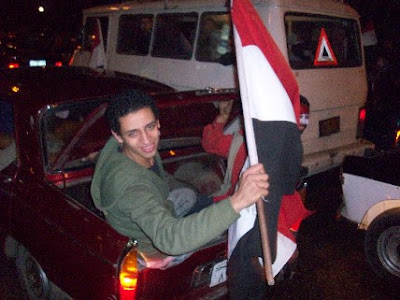
Travelling back in a taxi was eerie – like Melbourne at 4 am on a Thursday. Could this really be Cairo? One goal was scored by Egypt and just as we reached our destination another goal assured victory and mass celebrations. After salad roll (Roman sandwich) and ‘bumfrits’ (French fries, possible derivation: pommes frittes?), since ‘chipsy fries’ were not available, we headed to the main road to catch some of the atmosphere. The traffic was slow with Egyptian flags waving, people sitting out of car windows, crowded on the top of cars and even spilling out of boots. Horns were going crazy. Keith and Julie crossed to the medium strip to take photos which encouraged greater displays of flag waving, chanting and even a few fire flares being ignited. It was great to see and for days people were saying that we were getting discounts because Egypt won.
The next morning we visited the Egyptian Museum with the group and this time we had the benefit of Mamdoh’s knowledge. The three hours raced by. There were so many deities covering every possible eventuality that it was more than a bit confusing, and likewise for the pharaohs. As time has gone on, we have met the deities and pharaohs in the context of many different monuments and tombs and we are starting to become familiar with some. I really need a family tree that I could consult now and then – one for deities and one for pharaohs, although there is some cross over with some pharaohs claiming to be gods and not just representatives of gods. My favourite gods are Anubis, who wears a jackal head and is in charge of mummification, and Hathor, who can appear as a cow or just with horns on her head, and who is in charge of motherhood (and music, I think).
We have visited many temples and so I will give a bit of a summary rather than describe each one. The temples were surrounded by walls which defined the holy space. An entry, often grand and with enormous statues flanking it, led into an open terrace, usually with columns, and then came a roofed area called the hypostylum, often with small chambers off to the sides for a library or other purposes such as a treasury. Beyond that there is the altar in the holy of holies. All temples had a purification pool and some had Nilometers to tell how high the river was. The temples we visited have been in various states of preservation but each one has been spectacular and unique in some way. The Temple of Philae, dedicated to the goddess Isis, was flooded in the 1920s when the first Aswan dam was built. In the 1970s a wall was built around it allowing for that section of the dam to be drained. A raised area was created on an island and then the temple was moved stone by stone. The temple at Abu Simbel was built by Ramses 11, a pharaoh who ruled for a long time and made his mark in a big way all over Egypt. It was moved before the flooding caused by the Aswan High Dam and the creation of Lake Nasser in the 1960s. That temple was originally built into a mountain so they made an artificial mountain for it. UNESCO helped out because Egypt could not afford such projects by herself. The temples are richly decorated and usually have a section depicting the pharaoh making offerings to the gods, and usually there are hieroglyphics and either carvings or drawings of scenes depicting battles of significant events in the lives of particular pharaohs or the gods.
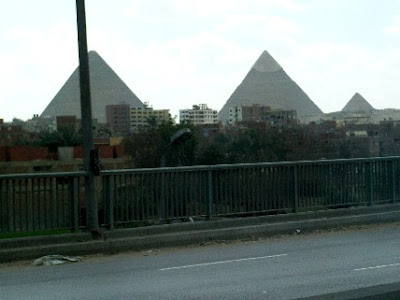
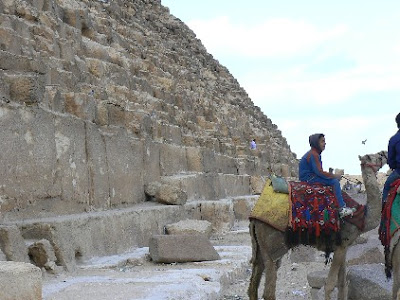
Back to day one of the tour (February 11th) – the Pyramids at Giza in Cairo’s southern suburbs. They really are spectacular and after a long explanation of their history and significance in an overheating bus, we were champing at the bit to get out and actually be there. This was delayed by driving up to the panorama spot which allows a good view of all the pyramids and the modern city beyond. At last we left the bus for a too-short look around and it was only then that the size and scale of the undertaking really hit us. Each stone is enormous and there are millions of them! I went into one of the pyramids (the Chephren) – down a low and narrow sloping passage just over a metre high in some parts, where the air seemed to be in short supply and getting thinner and hotter with every step. There were no decorations and the final chamber was surprisingly like a chapel with a pitched ceiling. We wished that we had had more time because there are lots of other buildings being excavated at the site, we didn’t have a close look at two of the pyramids or the several small pyramids and the whole experience was rushed. Visiting the sphinx was an even greater tourist race since it closes early, however it seemed to retain its dignity and a certain air of disdain for the masses of tourists and the postcard and souvenir sellers. Keith was disappointed in the box-like shape of its body and what with its nose having been shot off and then kept by the British, it was not the sphinx of our dreams.
A visit to the ‘Papyrus Institute’ started with a fascinating display of how papyrus was, and is, made properly and a warning to avoid fake papyrus which is made of banana leaves and will not last for thousands of years. To prove how strong papyrus is they asked Ken to try and break it and said he could have an enormous papyrus painting if he did. Well, he broke it and the promise was suddenly off. This was fundamentally a marketing exercise but at least we could wander and really look at the beautiful designs rather than just avoid looking at the ones being pushed on us by the souvenir sellers. We were stalked discreetly by a salesman who proved to be patient and helpful and then we received 20% off for Egypt winning the soccer, a free upgrade from a small design to a larger version of the same and finally a free papyrus as well. This was amazing since others in the group did not fare nearly so well, some not even receiving the ‘soccer discount’. Prices in Egypt are amazingly fluid, with a tourist price and a local price being poles apart and the seller always naming an enormous price to start with. For example, a musical instrument was 100 Egyptian pounds ($20 Australian), then 50, then 25, then 2 for 10 pounds. Another way to trap tourists is to name a low price and then to say that that price was in American dollars etc once interest is shown or that that price was for a different item. A packet of chips was offered for 20 Egyptian pounds at a tourist spot and the same packet is between ₤3 and ₤5 for Egyptians and ₤7 for tourists in the local supermarket.
Next was a cotton shop called Funky Cotton where some bought clothes, and finally we were on the sleeper train to Aswan.
Before bed we all met in the bar car where a funny waiter performed his parlour trick of balancing a glass on his forehead while belly dancing and the ladies in our group all joined him for dancing. Strangely the bar soon emptied of other people so we had it all to ourselves.
The trip took about 13 hours, most of it spent sleeping, but in the morning we could see that we were following the Nile and the fertile strip of banana and date palms, sugar cane and crops.


Celebrations in the streets of Cairo following the Africa Cup win for Egypt.


At the pyramids in the suburbs of Cairo


Saturday, February 9, 2008

Amman, Jordan continued

Keith and Christine would love to hear from you - comments, questions, news.
Please email either
windlechristine@gmail.com or
windle.keith@gmail.com

We had heard about the Dead Sea – so much salt in it (35%) that it is impossible to dive or sink and it’s increasing every year since it is only fed by the Jordan River which has had about 70% of its water diverted by Israel for reclaiming desert for agriculture. While shivering in Amman, Najib suggested that he take us for a day trip there for us to have a swim. One of the things about Jordan is that it has extremes of altitude in a relatively short distance so the temperature is vastly different. Leaving Amman’s 10 degrees, we travelled about 35 km and dropped about 1,500 metres to the Dead Sea where it was 26 degrees.

Before reaching the Dead Sea we stopped for a tour of the Baptism Site where Jesus was baptised by John the Baptist in the Jordan River. In those days the Jordan River was ‘deep and wide’ and followed a slightly different course – then through Palestine but now in Jordan. We visited the site where there is a cross shaped pool and archaeologists are finding and restoring some parts of the chapels that were there.

The mini-bus tour had an odd mix of devout, possibly Greek, pilgrims, general interest tourists like us and a contingent of US military and narcotics agents returning home from a stint in Iraq. This led to very different responses to the sites, with general interest in information and geography contrasting with collecting of holy water for blessings at home and jokes about imaginary snipers supposedly visible on the Israeli installations across the river. The river water was quite grey, carrying run off from the recent snows. Apparently some people drop into the river but disappointingly no-one did on this occasion. A shiny new and gloriously decorated Greek Orthodox church has been built at the site and other groups are building churches too.

Najib had patiently waited in the car and we set off again, listening in astonishment to the advice not to splash around because you can drown on the land from the salty water going into your lungs and preventing you from breathing, as an Italian tourist had. Most of the accessible parts of the shore of the Dead Sea have been privatised, with access for the public through payment to the hotels on its shore. We went to the one ‘public’ beach (Amman Beach) where we had to pay about 7 Jordanian Dinars each (about $10). The shore was planted with palms and studded with shade structures and plastic chairs for relaxing. It was a balmy day and we felt so relaxed and as if we were on a summer holiday. We were shocked by the burning sensation when we tasted the water and delighted by the feeling of lying back on a supportive massage mattress when we floated with no effort at all.

The day continued with a trip up Mt Nebo, which Moses climbed to see the Promised Land. There were spectacular views and once again we were impressed by Moses and his level of fitness. Finally we reached the town of Madaba, which is predominantly Christian, and visited the Church of St George, which is full of amazing wall and floor mosaics. It was a wonderful day all round and especially because of Najib’s excellent company and his knowledge of Jordan and its history and his affection for it.

We spent our second last day in Jordan with another couch surfer, Mindy, visiting her for the day in her Bedouin village of Sabha near the Syrian border. Mindy is an American Peace Corps worker, teaching English at the girls secondary school. We spent the morning at the school, were entertained with chocolates and tea as visiting dignitaries by the principal, sat in on a couple of classes, then wandered around the village. The year 12 class asked us questions. 1. Do you have koalas? 2. What do you think of the problem of the Palestinians and the war in Iraq? 3. What is your favourite animal? Year 8 were very excited by our presence and answered their comprehension exercise questions with amazing enthusiasm. Mindy took us to see some newborn camels at a Bedouin house. The woman invited us in for a glass of tea and we spent an hour having a conversation with her, translated by Mindy, who admitted she didn't understand some things that the woman was saying. Two main topics were her health (and a query as to whether we had any medications we could give her that would help her bad back), and that married women should cover up and dress modestly. I scored lots of points because I wore a long skirt and nodded sagely at appropriate moments. The woman’s two grandsons, aged about 12, were with us most of the time while we were inside and we wondered if that was because women are not supposed to talk to men alone except in the presence of male family members. Mindy had been concerned about Keith coming since she is an unmarried woman and it would be frowned upon for her to receive a man but eventually it turned out to be acceptable. We were received in a public room set aside for that purpose and although the daughters-in-law came in briefly, they did not stay. The woman wanted us to stay for a meal but we had already arranged to go to Mindy's house for a home cooked meal with another US worker who is vegetarian. We had been bracing ourselves for facing a Bedouin meal of rice and goat, complete with eyes and tongue which are kept for special guests. The meal we did have was delicious – stir fry, tomato and cucumber salad and bread. The bread had been bought minutes earlier at the local bakery, where we watched the bread making for a while. One man makes dough balls a little bigger than a softball. The next man flattens them out to a disc like a pizza base about 70 or 80 cm in diameter. The next man puts it in the oven for less than a minute then flings it onto the pile of cooked bread. This production line produces one of these huge flat breads about every fifteen seconds. We hadn't seen these huge pieces of bread before. Most places in Jordan have bread resembling the pitta bread we get at home.

We were sorry to say goodbye to Najib and Mohammad when they saw us off at the bus to Aqaba, heading off to catch the speed boat back to Egypt. We spent a relaxing afternoon and evening strolling around the town and foreshore of Aqaba, a terrible night in a cheap hotel where the bathroom allowed you to sit on the toilet, have a shower and clean your teeth all without moving and noises akin to minor explosions occurred all night, and set off for the port at 9.30 the next morning. In theory a one and a half hour trip, we finally reached Nuweiba in Egypt and completed customs at 4 pm. After waiting for a bus to Cairo to fill for an hour, we set off for a long drive and arrived there at about 11.30 pm. What a day of waiting and travelling but amazingly we have come to realise that timetables are not to be relied upon and that waiting is an essential part of any travel.

Thursday, February 7, 2008

Amman, Jordan

Instead of taking the bus to Amman, we and two other travellers – Chris and Gregor, both from Canada – shared the cost of a car making a return journey there. The driver, Abu Mohammad, was a Palestinian with 11 children who had been interviewed by a journalist about five years ago and whose story was published in a book called ‘Jordan – into the Fire.’ Remarkably, I had borrowed that book from the Geelong Library and had read that story. Gregor and Chris took turns to read aloud from Abu’s copy and then Abu talked about the disastrous effect that the war in Iraq and other political decisions have had on the economy in Jordan. The three hour trip went quickly and Abu took us to a bus station in Amman’s suburbs where we met Najib, our first ever Couch Surfing host.

It was freezing cold and heaped snow lined every street. Only narrow sections had been cleared for cars to pass through. Najib welcomed us warmly and took us to his house where we had a room to ourselves with its own bathroom. The idea of Couch Surfing is that you can provide or receive hospitality at no cost, share experiences and learn about each other and each other’s countries and cultures. During 2007 we had 8 lots of Couch Surfers visiting us in Inverleigh and we found it a very rewarding and enriching experience. We had selected Najib carefully, looking at the references other people had left for him and at the profile that he had written. He and his son, Mohammad, have now hosted 25 times through Couch Surfing and Hospitality Club, which is similar. They were so friendly and considerate, provided us with advice and assistance for seeing Jordan and were such excellent and stimulating companions as we sat around over meals, photos and music discussing and joking about all kinds of topics.

We stayed with them for five nights and will keep in touch, hoping that they will one day make it to Australia.

Our first day in Amman was spent visiting the Roman theatre. Amman is a city about the size of Melbourne. It was big in the time of the Romans and was then known as Philadelphia. However, as in Petra, the Byzantine and Muslim eras followed, along with devastating earthquakes. For many years Amman was deserted and so most of the modern town has developed in the last 100 years – only 2000 people in the early 1900s and about two million now. The centre of the city follows the dry path of the river it was named for and is located between two hills in a very narrow valley. On one side, with the hill behind it, is an enormous Roman theatre,

and across the valley, easily within walking distance, the Roman Citadel sits on top of the hill with the pillars of the Temple of Hercules and the wall clearly visible against the sky. We had borrowed a guide book to Jordan and, in following its advice for those who like challenges, we walked from the theatre to the Citadel, climbing steps to change levels (sadly not the ones in the guide book since we found others that looked OK and only the smell when we were half way up told us their regular current day use),

and finally scrambling up between houses in what appeared to be people’s back yards. Imagine a hill terraced to allow for houses with 45 degree slopes between and about 5 layers of terraces before you reach the top.

Behind the last terrace, rubble (tossed over by the Romans and everyone else since) festooned the slope

and we climbed over it into another world – extensive ruins, ongoing Spanish Archaeological digs, and a museum with a finely sculpted marble hand on the steps that had come from a nine metre high statue of Archimedes.

A jarring note but entertaining - small boys did ask us if we had a lighter or any cigarettes and they rampaged over the site obviously without a thought for history but with a vigour that a Roman Commander would have admired.

Another hiccup – when we tried to enter the museum we didn’t have a ticket for the site since we had entered over the ramparts so we had to go down to the gate and enter again.

After a long ramble through the ruins we descended by some pristine steps and bought some freshly squeezed orange juice – at least ten oranges to the glass (yes, real glass) for about 1 and a half Jordanian Dinar – about $2.40 Aust. Then we went shopping in the fruit and vegetable market because we were making the evening meal.

Despite not being able to read Arabic and no-one speaking English except to say ‘Welcome to Jordan’, everyone was very helpful and allowed me to taste unknown items and assisted if we had problems with the smaller amounts of money. I was making Spinikopita and vegetables and salad – cheeses and herbs and spices and pastry as well as vegetables – so a bit crazy but I was courteously served with my two eggs and one onion etc. We asked a random shop assistant where to get a bus and, despite the fact that he could speak no English at all, he waited by the side of the road and then hailed the correct bus for us, even though it was moving along in the second lane of a busy road. Everyone goes out of their way to be helpful and, unlike in Egypt, there is no-one who is seeking payment or an opportunity to sell us something or extract money from us. The reason we didn’t know where to find the bus stop was that kind fellow passengers had got the bus driver to stop right at the Roman theatre in the morning instead of us having to walk back from the bus station!

An excursion to Jerash, North of Amman – the most complete Roman town outside of Italy – on a beautiful day of 22 degrees, let us experience the grand scale of public building and pomp in Roman times.

Grand colonnaded streets, processional staircases, fountains dedicated to Nymphs, Hadrian’s Gate (a little something knocked up to please Hadrian when he visited),

Temples to Zeus and Artemis, an oval terrace, two theatres and a chariot racing track (the Hippodrome, where races are still staged for tourists), markets, bridges – everything larger than any modern city planner would suggest.

I was enticed into putting my finger into the join in a column at the Temple of Artemis so that I could feel how the columns sway because they are built in such a way to allow for movement – from wind and to allow for less impact from minor earthquakes.

There are the ruins of several Byzantine churches and one had exquisite floor mosaics in very good condition – it was like coming upon a treasure in a place where all colour has long since disappeared.

The final surprise came as we approached the South Theatre. Were we really hearing the Skye Boat Song and Scotland the Brave played vigorously on the bagpipes? We were indeed and inside, in front of the imposing columns and carvings, a small band from the Jordanian Army – originally trained by the British and hence the pipes – was playing for donations.

One spot on the floor allowed for an outstanding echo and projection of our voices.

Sadly we didn’t know where the bus stop was since we had again hopped off at the ruins at an unofficial stop. This time a young Arabian accounting student said he was also going to Amman by bus and to follow him. The bad news was that the last bus had already left (4.30 pm). Our student suggested that we take a lift with a worker returning to Amman who charges about the same as the bus, and so five passengers piled into a black utility and set off to Amman. The time passed pleasantly, chatting about the student’s studies and family, and we tried not to be anxious about the fact that this car was doing the trip in a quarter of the time that the bus took. We were incredibly lucky that the student spoke sufficient English to help us, since we were dropped off in an unfamiliar part of Amman. He found the correct bus for us to get back to Najib’s and stayed with us until we were organised. The kindness of strangers made us reflect on what would happen in Australia in such circumstances, when someone does not have the language to follow verbal instructions. We learnt that we really need to find out when the last bus goes, where the bus stop is, to have destinations written in Arabic and always to leave more time than we think things will take.