Monday, April 7, 2008

Rhodes, Greece to Marmaris, Turkey, Tuesday April 1st

Keith and Christine would love to hear from you with questions, comments, personal news and any news at all from Australia or wherever you are. We will reply to all emails!

Please write to either

windlechristine@gmail.com or

windle.keith@gmail.com

We left the little village of Maritsa on the 7.10 bus, along with the secondary students. Our aim was to contact Frey, post some parcels, find somewhere to leave the backpacks for the morning, purchase ferry tickets and visit the archaeological museum and palace – all before 1 p.m. when we had to be at the port. Nothing was open when we arrived so our plans were somewhat thwarted. Eventually we headed off to the old town after 10, with our first priority being to find an internet café. Pleasurable when you want to wander around casually, it is the maze from hell when you are looking for a particular place in a hurry. Eventually we gave up the search and found the museum.

The archaeological museum was in the Hospital of the St John’s Knights. The order was formed to minister to the sick and wounded on the crusades and in Rhodes they were assigned a defensive role by the Genoese. The central courtyard was surrounded on all sides by archways and porticoes where some stone items from various eras were displayed. Going up the grand stairway from the courtyard we came to a second storey with rooms opening up on three sides and an enormous chamber opening up on the fourth side above the entry arch. The rooms housed ceramics, glass and metal items found at various sites around Rhodes and were remarkable for providing almost no information apart from dates. The most interesting ones contained statues, including the very beautiful and delicate Aphrodite of Rhodes, sculpted in the first century AD.

When we entered the great hall there was a kind of hushed atmosphere befitting the many gravestones and carvings relating to the knights. The sarcophagus belonging to the grand master, Pierre de Corneillan, who died in 1355, had a plaster cast of the original carving of him resting in a dignified and peaceful way, on the top. The real carving is now in France. It was so frustrating because there was so little information anywhere and we felt that we didn’t know anything about the knights. I wanted biographical details and how they spent their days and if you could ever retire and are they related to St John’s Ambulance etc, etc. On the way out I asked the guard whether there was a display somewhere in Rhodes devoted to the story of the knights and he indicated that the only way to find out more was to buy a book. He said that the whole city is a museum, and seemed to imply that there was something wrong with me if even a whole city could not satisfy me.

Far more interesting and graspable for me was the Decorative Arts Museum, which set out folk art from the last five or so centuries from the Dodecanese Islands. It had a lot in common with Bavarian folk art. Carved chests had painted scenes inside the lids and other carved pieces, such as bed ends, were complex and featured plants, animals, birds and patterns. There were beautiful displays of plates and, in one corner, the room of a weaver’s cottage had been set up. Everything spelt out care, craftsmanship and pride in what can be made and cherished, and it all really spoke to us of the people and their lives.

We gave a quick glance to the ruins of the ancient temple of Aphrodite and headed off to the port, where we had to pay port tax an hour before the ferry left. All in all, being in the city of Rhodes was an experience not to be missed, and I will have to fill in some knowledge gaps from the internet later.

The ferry pulled in, fairly small and flying the Turkish flag. People disembarking had to go through customs and I saw that every bag was checked very thoroughly. We knew we had to pay the port tax at a locked wooden canteen-like building, so when a man on a motorbike appeared, unlocked for two minutes and then hopped on his motorbike, I rushed over to see him. We engaged in a strange game of twenty questions in which I asked ‘Do we pay the port tax to you?’ ‘Yes.’ ‘Can I pay it now?’ ‘No.’ ‘When do I pay it?’ ‘One hour before departure.’ ‘It is less than one hour before departure now.’ ‘Pay at three o’clock.’ ‘Won’t the boat have left by then?’ ‘No.’ ‘The boat to Marmaris will not leave at 2 o’clock?’ ‘No.’ ‘When will it leave?’ ‘Later.’ ‘What time will it leave?’ ‘4 o’clock.’ Aaarrrggghhh! Exhausted by this exchange and our early rising, also encumbered by our big packs, we blobbed out, chatted with other relaxing travellers and read about Turkey.

Eventually we could board the ferry and it was just how I had imagined the ferries around the islands would have been. We sat in a small enclosed but windowed top lounge room, seating about 20, with very friendly people in what can only be described as a party atmosphere. Two of the men were British and lived on boats, mooring at different Greek Islands over the summer. One home schooled the two children and then worked as a helicopter pilot in Cairo for three months of the year. Two young Australian women from Yass told of scraping their hire car on a stone wall on Santarini. They had been sleeping in it to save money and that one move cost them 180 Euros, undoing all their economies. A mother and son from England were holidaying in Marmaris and had gone to Rhodes for a day. She was so patient when he continually put her down and treated her like an idiot. Travellers from Melbourne had been to Lindos on Rhodes, a place I would have liked to go, and they told about their experiences. A Brisbane couple had lived in England for a year. It was like being on a live Michael Parkinson show, with just a hint of Oprah thrown in.

Every now and then we braved the freezing winds to walk around the deck, holding on to the rails to ensure that we did make it safely to Marmaris. Eventually the misty mountains grew clearer and the gap into Marmaris Harbour came into focus. At last houses and hundreds of yachts and other boats were clear and finally we arrived.

Finding ourselves in the customs queue in front of the Brisbane couple, Nigel and Sue, we chatted some more and eventually shared a taxi to a pension recommended in the Lonely Planet Guide. Nigel went in and negotiated a very good price – off season, two double rooms etc. Best of all we had access to a kitchen and the internet. We had food so I cooked for the four of us while Nigel and Sue set up some tables on the terrace and provided some starters and a bottle of The Knights of St John of Rhodes wine. We enjoyed each other’s company and the food was delicious.

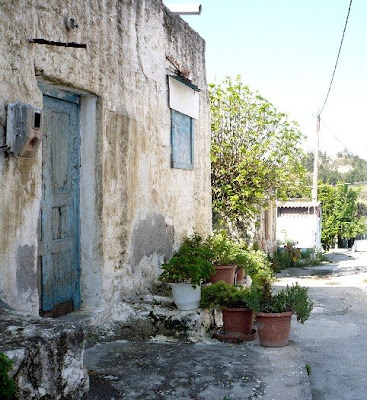
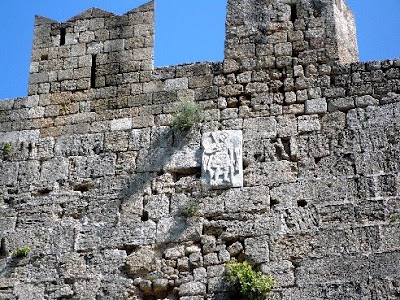
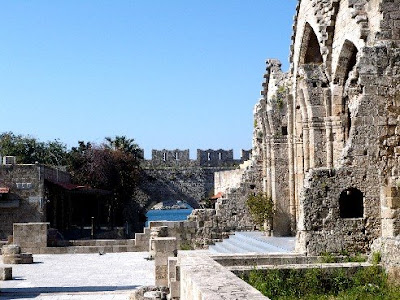
The stonework in Rhodes is deteriorating and seems to be getting eaten away.

Approaching the entrance to Marmaris Harbour, where Nelson and many other naval leaders have gathered their fleets in preparation for battle or invasion.

Sunday, April 6, 2008

Maritsa, Rhodes, Monday March 31st

Keith and Christine would love to hear from you with questions, comments, personal news and any news at all from Australia or wherever you are. We will reply to all emails!

Please write to either

windlechristine@gmail.com or

windle.keith@gmail.com

We woke up later than we had anticipated so perhaps our bodies were still on pre-daylight savings time. We anticipated that the next bus from the village to Rhodes Town was nearly due so we set off to catch it. The man at the kiosk beside the bus stop, not an English speaker, said that the bus would come at one, then in consultation with another man, changed that to 11. It was only ten o’clock so we strolled around the village.

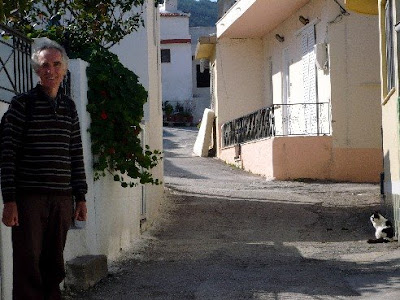
People were very friendly, greeting us and commenting on the weather. We would have been very noticeable in a village with no accommodation for tourists, obviously going nowhere and just out for a walk.

Eventually, at nearly eleven, we returned to the bus stop to wait for the bus, which eventually came at twelve. I spent the time taking photos of many of the people who passed by. Later that evening, when we showed John the day’s photos on the computer screen, he enjoyed seeing his neighbours and was particularly interested in a lady of his vintage who he said took in washing, and who was very good at specialty items. I guess that means embroidered items, lace and fine fabrics but there was no way to check details.

The road to Rhodes passed through neighbouring villages and then suburbs lining a beach front. Corporate groups were battling it out in beach volleyball, soccer and rugby. In the distance, the misty mountains of Turkey gazed out over the pale blue sea. We made a quick trip to the Internet café to ring Frey on Skype for his birthday but it was already nine o’clock in Australia and he was in bed asleep. He turned four, and we are really missing seeing him and his little brother Yonah grow and develop.

A little history - Rhodes is the second largest Greek Island after Crete. The Dorians used it as an important outpost after they arrived in 1100 BC. At that stage there were three autonomous states on the island, based on the cities of Kamiros, Lindos and Ialysos. All went well until Roman times when the island seemed to be incredibly fickle in its allegiances, changing to the winning side whenever possible. Its loyalty would have been worth little, but its prosperity and geographical position must have made others want its support. In 408 BC the three states consolidated in one new city – Rhodes. Having recently fought against Athens in the Peloponnesian wars, it now became an ally of Athens to defeat Sparta. Showing poor judgement, Rhodes then backed Persia against Alexander the Great, but when they saw how things were going, joined Alexander’s team. They were besieged by Demetrius Poliorketes, held out, and to celebrate built the Colossus of Rhodes. It was a 32 m high bronze statue of Helios Apollo, and was one of the seven wonders of the ancient world. Rhodes was going up and up in influence, power and artistic and intellectual endeavours. Unfortunately, when the Roman generals were fighting for leadership of the Roman Empire, Rhodes backed Julius Caesar who was then assassinated (44 BC). Cassius besieged Rhodes successfully and took its artworks and treasures back to Rome as both booty and retribution.

The history continues to be complex because from this point on Rhodes was a diminished entity and was not really standing and fighting alone. It was being given away as part of treaties. In the split of the Roman Empire, it went to Byzantium – the eastern half of the Empire. The crusaders took Constantinople and made Rhodes independent. The Genoese took over and installed the Knights of St John in 1309. After 213 years the Ottomans invaded and ruled for nearly four centuries. The Italians occupied Rhodes from 1912 until after the second world war, when it became part of Greece, along with the other Dodecanese islands.
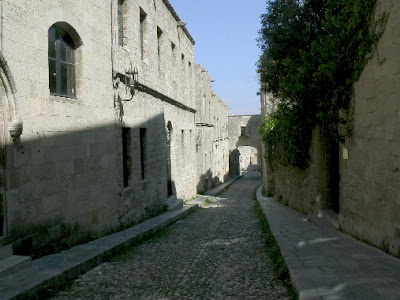
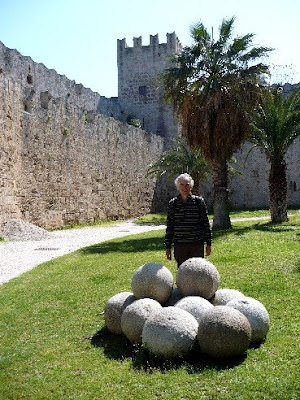
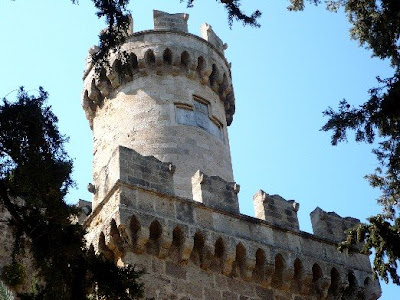
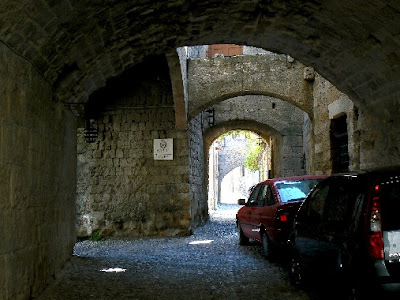
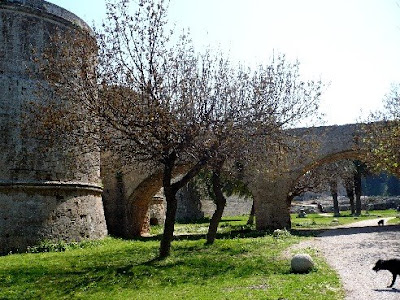
The old town at Rhodes is so interesting and also visually very appealing. There are stone walls that are intact and in good condition, with turrets surrounding a second, similar wall. Between is the dry moat which allows for a second line of defence if enemies penetrate the outer wall. They are, in effect, trapped, with nowhere to go to avoid catapult balls, boiling oil and firing. Entering through an arched tunnel, we came to lower walls and a gateway. The roads are tiny cobblestones. The stones are egg shaped but lie on their sides so that only a small surface is upwards. Millions of stones are needed for even a short distance. Some areas have been placed in the local form of black and white mosaic. When cobblestones are wet, as they were on the night of our arrival, they are incredibly slippery.
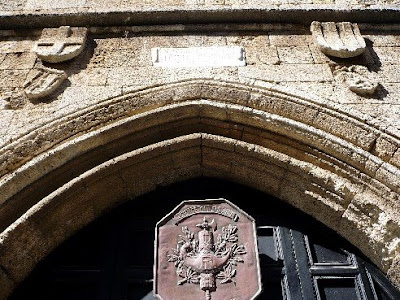
We had two fairly vague maps so we decided just to amble along and see what we found. The whole old town is World Heritage listed and, although it is home to thousands of residents, it is a museum. Every step reveals beautiful vistas, interesting architecture and often inscriptions and carvings in the stone; usually coats of arms for the various groups of the Knights of St John. The town was divided into three major sectors – the Knights’ sector where the knights had their lodgings, the Hora (or Turkish sector) which was the commercial centre and the Jewish sector. Today residents live in the Hora and the Jewish sector, with the Knight’s sector being used as offices and consular buildings. The Hora is now very oriented to tourists.
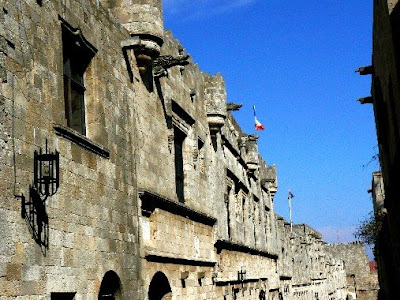
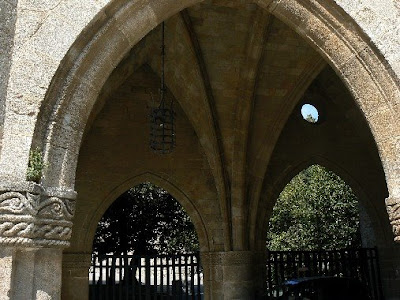
Walking down the Avenue of the Knights, we passed the fairly grim and business like facades of the Inns of the different language groups that comprised the Order of St John. They were England, France, Germany, Italy, Aragon, Auvergne and Provence. Each group was ruled by a bailiff under the auspices of the Grand Master, and was responsible for the defence of a different part of the bastion. The buildings were austere but were relieved by arched sections which I imagine could once have been set up taverna style. The inns were used for entertaining dignitaries or for relaxing with a knight’s own language group.
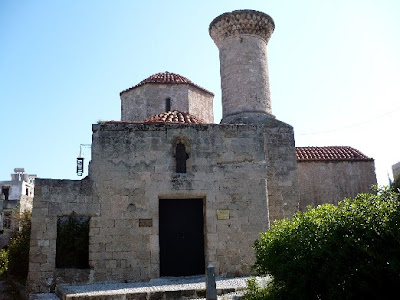
Churches in the old town were converted to mosques under the Ottomans, and there was an interesting one which still had a dome on top, but a Virgin Mary statue reinstated by the Italians on the front. The Italians did massive restoration work in both the old and new towns. In particular they restored the old Grand Master’s Palace for Mussolini to use, but he never went there. They also built many Italianesque buildings in the new town which give the place a gracious air.

We enjoyed rambling around the old town, coming upon the Square of Martyrs, where a memorial commemorates the thousands of people who died in concentration camps during WW2, a fountain with Ottoman influenced designs, the Turkish bath, which is still operating commercially today, and the mosques and churches. Some alley ways are only as wide as a lounge chair. Gunpowder, stored in the belfry of an old church, had exploded and destroyed the building. Someone made a big error with that one! A school was subsequently built on the site, but now excavations have revealed the foundations of the old church.
On the way to the bus we bought some ingredients to make a tea for John and us but when we arrived, John already had everything under control. I went off for a shower and Keith read, since our chef did not want any assistance. John enjoyed the photos of our day’s outing and was very disappointed to hear that we were leaving for Turkey the next day. We had wanted to stay a bit longer but the ferry schedule and our next plans didn’t allow it. Dear John invited us to come back to visit next year and to stay three months. It is amazing how affection and respect can grow in a short time. His health would not allow him to travel. We all agreed that Maritsa is a beautiful village and area.
This church was at one stage converted to a mosque. The tower in the photo is part of the minaret.

Thursday, April 3, 2008

Maritsa, Rhodes Greece, Sunday March 30th

Keith and Christine would love to hear from you with questions, comments, personal news and any news at all from Australia or wherever you are. We will reply to all emails!

Please write to either

windlechristine@gmail.com or

windle.keith@gmail.com

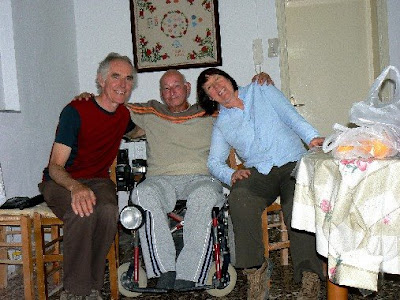
Rising at about 11 am, we met our host properly in the kitchen. John has problems with his feet, lower legs and back, which have increased over the last ten years. In addition he was in an accident which affected the nerves in his right arm, and that is starting to be a problem. He is very happy with his wheelchair and goes everywhere in the village. He grew up here so he has many friends and relatives around.

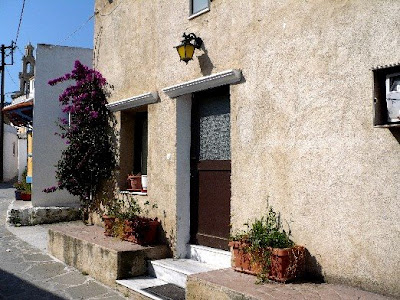
Maritsa, the village, is just a delight. It is a lovely size with all the advantages of the buildings being very close to each other and with squares and communal spaces, yet with the countryside only a ten minute walk in any direction. There is a primary school and it was good to hear the sound of happy and loud children enjoying recess. The cafes have a very relaxed atmosphere with arm chairs and couches. We tried one because we couldn’t put in the new phone credit with only Greek instructions, so we bought some cappuccinos and the barman fixed our phone.

Just after we had woken on the first morning, and while we were trying to work out what John explaining to us, Michael arrived on his brother’s motor scooter. Michael’s own car was burnt while it was parked at the post office. Someone stopped to fiddle with their battery and their car caught on fire and burnt half of Michael’s car too. He had borrowed his brother’s car the night before to collect us. It turned out that daylight saving was starting and we had to put our clocks forward. John had already kindly fixed my watch while I tried to follow why he was doing it.

Michael had come over to roast some chicken for his father. He lit a fire and then set some home made charcoal in a burner on top of it.

Since he had a little while before the roasting started, and since Keith had announced he was having a shower, Michael and I drove off on the motorbike (no helmets, Greek style) to see the charcoal house.

The family has plots of land belonging to John’s generation. On one of the plots, Michael has a small, round building, which has two layers of walls with sand in the 60 cm gap between them. The roof is the same. There are holes all around at ground level and at about 45 cm up. Wood, with the best being olive wood, is stacked inside and lit. Everything is eventually closed off and left for several days. I gather that progress is controlled by judicious opening of the holes, with the second day being notable for the smoke that pours out. Unfortunately cheap imports from Egypt have meant there has been a slump in charcoal sales.

Since we were out and about, Michael and I visited two monasteries that are not far away. At one spot, dedicated to Saint John, there are the ruins of an ancient church and a recently built church. John told me that people go there in August, have a feast with lots to eat and drink and sleep the night. Butterfly Valley is not far away but is bereft of butterflies at this time of the year. The hills are covered in cypress and pine trees. Apparently the ancient forests were used up by people and the Italians set about a program of reafforestation during their occupation of Rhodes from 1912 to 1945.

The roasting completed, and a meal of salad, cheese and potatoes prepared, we sat down to eat. Our dirty clothes were swishing around in the washing machine. Michael departed, and after lunch and hanging up the clothes, we just lay down for a ten minute nap that lasted more than an hour. Michael said that Greeks are very big on food, on taking time to prepare it and to enjoy it. He himself had not eaten anything all, and John said that he is very careful not to eat too much and not to drink.

Finally waking up, we set off for a walk in the country and I was an excellent guide since I had had a preview. The countryside around is just like a chocolate box lid or the picture on the Derwent coloured pencil tin. Every turn in the road reveals a scene that looks like it was specially set up to be the ideal of Greek countryside.

When we returned, John had made a beautiful vegetarian stew. He is so kind and can’t do enough for us. We showed him the photos we had taken at Maritsa and in other places too, but they were reduced size so not so clear. Later we all watched the circus on TV together – something that transcends language.

Sometimes we find conversations difficult, but John tries so hard to find some words that we all know. It is a great help that he was in Australia for six months because lots of place names ring a bell and we can work out what he did there. He built houses in Dandenong and Doveton, and also worked in a bakery and a cheese factory. He visited Frankston and Dromana. I approach it by accepting that we are speaking a hybrid language with charades and drawings, and amazingly, once you stop thinking that Greek and German are languages you don’t know, you can pick out quite a lot. Keith found the going more difficult and often had no idea what was being discussed. He paid me the great compliment of saying that I was just like my dad, who had infinite patience and could glean meaning from the barest linguistic evidence when speaking with some of our migrant friends.

Santorini to Rhodes, Greece, March 29th

Keith and Christine would love to hear from you with questions, comments, personal news and any news at all from Australia or wherever you are. We will reply to all emails!

Please write to either

windlechristine@gmail.com or

windle.keith@gmail.com

The port had been calm but the sea was rough, with the ferry seeming to plunge up and down as well as sideways as we churned on. The smell of diesel from the vehicles entering the hold seemed to linger and even to pervade my cabin. Strangely, I seemed to be in a cabin with men and since I had not been with Keith when he bought the tickets, I assumed that the mixed room was cheaper. I put my nightie on the bed and went up to sit with Keith. He had not booked me a mixed cabin and said that even if I wasn’t fussed, he was and that the men might get a shock when they woke up. Also, was I on a top bunk? I went to see the purser and was given a new cabin with no-one else in it as yet. The steward suggested that Keith could come down but would have to leave at the next port in 4 hours time in case a lady had booked the cabin. We were both so tired that waking up in 4 hours time did not look like a good option. Keith retired to a comfortable and spacious spot on the floor upstairs and I went to bed.

At Iraklio a lady joined me and she fell into a deep sleep which lasted until the 10.30 p.m. landing at Rhodes. She must have taken a sleeping tablet since there was plenty of stopping at ports, noise and rolling movement.

I rose at midday and returned for an afternoon sleep from four to six and then took a shower. The day was spent reading, chatting to other travellers and catching up on typing and photos. Keith slept reasonably and then drifted off in his chair now and then during the day. We ate twice (the usual bread, cheese and salad) at odd times and weren’t sure technically what meals they were.

We met Barbara and Keith, an inspirational couple who have travelled extensively all their lives. Before they had children they travelled for five years. Now they make a trip of many months each year. They had some good tips for us and interesting stories of their travels in out of the way places as well as in Europe. Another passenger, Paulina from Poland, speaks five languages and is working on the island of Symi, between Rhodes and Turkey. She works in the summer selling jewellery and in the winter visits her family and her boyfriend who is studying in Crete. She said Symi is absolutely swamped with tourists in summer and when winter comes, it is hard to make a living and many tourist industry employers close down. It means you have to try to make your year’s salary in a few short months or seek work elsewhere.

As the ferry approached the port, we were looking forward to meeting Michael, our next coach surfing host. He would be there to meet us and to take us to his home in Afantou, about 25 km south of the port at the city of Rhodes.

A slight hiccup was caused by our phone running out of credit, so when we arrived we were not able to contact Michael with the exact time. A kind person made the call for us on his phone and, after a short wait, Michael arrived.

Michael is a frequent traveller to Thailand, Cambodia and Vietnam. He has friends from many countries and lots in Australia where he hopes to visit one day. Although it was the middle of the night, he took us for a tour of the places we might visit in Rhodes. It was really helpful to get our bearings since there is the old town, the medieval town which still has many people living in it, and the modern town. From the port we had been able to see the massive walls that encircle the town. Michael drove in one of the seven gates and stopped so that we could check opening hours at various venues. In the new town he gave us a look at the bus stops and timetables and the cheapest cafes, and then took us to his father’s place. It was now nearing 1 am. Michael lives with his mother in her village but we were to stay with his father because his father has more space. We had had no idea about this arrangement. Not surprisingly, Michael’s father, John, was in bed, but he cheerfully welcomed us. John speaks Greek and German and a very little English. I thought how amazing he was, at seventy-two and in a wheel chair, to welcome total strangers into his home with very little in the way of language in common.

Michael is a very well organised and thoughtful person who now set about making us a meal, since there would have been little to eat on the boat. He had not remembered that we are vegetarian so he had bought a chicken to roast outside. Not at all fazed, he whipped up a green soup with lemon and olive oil which was delicious. All the while we had been chatting, with Michael telling us about his travels and his job as a baker. He left at about 2.30 am and we went to bed.

As there were not many passengers on the ferry, Keith was able to spread out over several seats, one table and a space on the floor where he slept.


Santorini, Greece, Friday March 28th

Keith and Christine would love to hear from you with questions, comments, personal news and any news at all from Australia or wherever you are. We will reply to all emails!

Please write to either

windlechristine@gmail.com or

windle.keith@gmail.com

The caldera is spectacular – the only disappointment for me was that I had anticipated being able to see down through the water to the collapsed rocks, perhaps with some bubbles rising and even better if a little lava was leaking. Maybe there is scope for a sound and light show specialist to cater for tourists like me. We viewed the caldera from many spots on the island, always with awe at how vertical the sides are.

The archaeological museum at Fira had an interesting collection of ceramics, and we were able to recognise the indicators for some of the different eras. The difference between the geometrical patterns on 7th century BC ware and the flowing animals and humans on 6th century BC ware is obvious if you know what to look for. There was a frustrating lack of information. Many of the items were from Ancient Thera, a site we then set out to visit.

Ancient Thera was built on the top of a mountain. We walked the two and a half kilometres to the top, the weather deteriorating from windy to driving rain. As we reached the gates lightening and thunder raced around the mountain top. We scuttled towards a little church and joined a group of about eight American quad riders who were seeking refuge from the weather too. After a while, with the sky continuing to darken and flashes of lightening coming closer to the thunder, they decided to give up and ride back to the town below. They offered us a lift but we were hopeful of an improvement so we opted to stay for a while. Eventually, with closing time only fifteen minutes away, the guard came in and said he was going soon and that the church we were in was not safe since the walls had cracks. In addition he urged us to check our ferry since the seas were churning violently in the storm. I took off my camera to put my jumper on under my coat and we set off down the mountain. We had not even glimpsed one stone of Ancient Thera.

We drove down to the black beach where the surf certainly was wild.

I got out to take a photo and discovered that my camera was missing. It could only be up the mountain in the little church, behind the locked fence of the Ancient Thera site. We drove up the mountain in the hope that the site worker or the guard were still around. The place was deserted but at least there was a break in the weather. Keith scaled the gate, collected my camera, and climbed back out again. Afterwards I thought that it was lucky that there wasn’t an alarm or watch dog. What a hero!

Having seen the black beach with tiny black stones that in summer become so hot that you need thongs on and a mat to lie on, we drove off in search of the red beach. The island is about 16 km long but every road is a windy one and you need to go in various directions to end up where you want. The way to the red beach passed the Akrotiri site (supposedly like Pompeii), where some modern walls and lots of signs for contractors were all that we could see. A little further on there was a cluster of tavernas, all belonging to some captain or other.

Eventually we reached a church built against the rocks on the headland. The cliff above it was red, with many huge red boulders lying at its base. Graffiti had been obliterated by painting over it in red, unfortunately not quite the perfect match for the rocks. Someone had even graffitied white crosses on the rocks just above the church.

Braving the wind we walked along the track beside the sea and came to the spectacular red beach. It has red scoria sand and red cliffs. The sea looked blood stained as the scoria rolled about in the heavy surf.

We were keen to get to Oia before the sunset, hoping for a good one tonight. We called at the supermarket and collected Frey’s gift, plus supplies for the 18 hour ferry trip that would start at 4.10 am. The sunset was dismal and the streets, which have no rain absorbing garden sections, were streaming with water. We visited the Atlantis book shop and chatted with the two girls working there. The shop was started by a group of friends who visited Santorini and though it was perfect except that it lacked a bookshop. They purchased a site and set up the shop with accommodation attached. The girls currently working there are not paid; they are family friends of the owners. They have free accommodation in return for working for a month or two. They told us that hotel rooms in Oia are very expensive, hundreds of euros a night. Thank goodness we stayed in Fira. The shop was a delightful trap, and despite the one book at a time (because of weight) rule, we left with two. They are Orhan Pamuk’s ‘Istanbul, Memories and the City’ and ‘Christ Recrucified’ by the Greek author, Nikolas Kazantzakis.

We parked in Fira and Keith prepared some photos for the blog. Our tea was copious amounts of chocolate milk. Since we were not able to find out any news about the ferry, we had to assume it was as scheduled. After some internet time, we drove down to the port to sleep in the car outside the car hire place. At three o’clock the action at the port started and by four we were aboard.

Santorini was a very interesting island to visit but, without a car, the bad weather and distances would have meant that we could not have made the most of our one and a half day visit. We had heard of, but not seriously considered, ferry delays, so it was a bit of a wake up call for us and made us realise how lucky we have been weather wise to date. Apparently Santorini is extremely crowded in the summer and really does take on an all night party atmosphere. Although people were out and about at 11.30 pm while we were there, the tone on the streets was fairly quiet.

Walking up the mountain to Ancient Thera there were lots of wattles in bloom.