Keith and Christine would love to hear from you with questions, comments, personal news and any news at all from
Australia or wherever you are.
We will reply to all emails!
Please write to either
windlechristine@gmail.com or
windle.keith@gmail.comApproaching the travertines from the valley, we passed the ticket office and paid 10 lira ($8.30) each to enter. Our first stop was the museum which was housed in the partially restored main baths. The Italians are leading the archaeological projects here and each summer they take more steps in uncovering and sometimes restoring areas. This is a monumental task when you consider that Hieropolis was an extensive city with a necropolis (cemetery) alone stretching two kilometres. On top of earthquakes, there is the problem of massive erosion from the mountain and calcified rock deposits, sometimes two metres thick, in areas where spring water has run. They had to use pneumatic drills to reach the marble paving of Frontinus St. (its real Roman name, although it sounds like a comedy spoof).


 Like Ephesus, Hieropolis had been a prosperous city with lavish statues and stone friezes on public buildings and the homes of rich individuals. Drawings of what the city would have been like show that commercial and public buildings lined a few main streets with residential areas filling out the rest of the area. Unlike Ephesus, which can be looked at by following a fairly straight course, Hieropolis has ruins in various stages of excavation and preservation over a very large area. We cut across from spot to spot on side streets where it was clear to see the deep drainage systems under the marble, along the top of covered water channels and simply through the flower and stone studded grass.
In Roman times, and even now, the curative properties of the spring water were known and used. A resort town in Roman days, it had been reduced to a village by numerous earthquakes and finally abandoned. In modern times a string of hotels sat on the plateau and utilised the spring water for health holiday packages, with the result that the natural water flow to the travertines was disrupted and they deteriorated and became discoloured through pollution. In an effort to save the travertines, the hotels were demolished in the last 20 years and relocated to the outskirts of a nearby village. The travertines are now listed as a World Heritage site.
The vast site of hieropolis is a reptile’s paradise. A snake of over a metre sunned itself on a rock in front of the Nymphaeon, slithering into a nearby hole as we approached. Keith took a photo and later it was identified as a venomous species. A little further up the hill a sandy coloured lizard slightly smaller than a blue tongue delicately stepped off into the grass. Finally, on our hike up to the village, we met a lumbering turtle which stopped and pulled in its head in the hope that the giants would soon move on.
 Highlights of Hieropolis
The museum – lots of well preserved statues and stone work, many of which were sequences of stories about the gods. In one, there was a competition for who was the best musician, with Apollon playing a lute pitched against Marsios on a shepherd’s pipe. First round was a draw but in the second round, the Apollon played his instrument upside down and won - reminds you of some rock stars. The winner didn’t like having been challenged so he asked a friend to skin the other guy, which he obligingly did. Later the winner regretted all this so he arranged for the dead opponent to be turned into a river. This was one of the less gruesome stories. There were also many household, medical and ceramic and glass objects including a ceramic iron and a strange hook called a body cleaner.


 Seeing the impact of earthquakes – some parts still standing clearly show realignment of the stone slabs and the site is literally strewn with columns, carved stones, parts of sarcophagi and walls.
The theatre – it is the first we have seen to have the stage area of the theatre in good shape. The curved area at the foot of the tiers of seats would often have been used by musicians, and the stage proper was raised above and behind that. It had statues of gods along it and doorways into a back stage area. The tiers of seats were extremely steep and there was a modern wooden fence halfway down to prevent visitors toppling down too far.


 St Phillips Martyrion – St Phillip and his father were killed here and a basilica was built over their tombs. This was remarkable because the centre was an octagon surrounded by eight chapels. Although the huge arches leading to the chapels had fallen, it was clear that they would have been very impressive. It was on a high point, apart from the rest of the city. It told the story of religious change over time.
The Nymphonian – absolutely enormous and over the top (even for the Romans) with lavish decorations. It was a public fountain and water supply.
The poisonous gas – We didn’t actually find this but it has claimed the lives of curious tourists and we did search for it. We saw men from the Ministry checking the protective fencing around a likely hole in the right area so that was possibly it. In ancient times there was an oracle at Hieropolis and the interpreting priest was the only person said to be able to survive the gases at this spot. He would throw animals and birds in to impress people with their instant deaths.
The Necropolis – lots of people died in this health resort. At least two kilometres of cemetery with elaborate expensive tombs, some of which are like small houses while others are shaped as mounds. Enormous stone sarcophagi, usually for containing remains like a coffin, were used decoratively on top of the tombs. Some inscriptions gave rules for how the public should treat the tomb, including curses for those who disobeyed. One described payments to the wool dyers guild for perpetual maintenance of the tomb surrounds.

 We climbed up to the village where our friends of yesterday were preparing a Turkish meal for us. We stopped first at the carpet shop to see if they were there, and a villager came to ask us if we were lost and looking for St Phillip’s Basilica. Clearly only lost tourists make it up there. He called our friends on the mobile and Huseyin drove down to pick us up. The villager came along for lunch too.
There is a wide covered porch area in front of their house with mats on the floor and benches against the wall. We all took our shoes off to step on the mats. We had taken the gift of some peach juice and biscuits, along with a couple of small koalas that slip onto pencils. Another neighbour appeared and joined the lunch group. It is customary to share food with any neighbours if the parents, particularly the mother, is not at home. A boy of about seven came home from school at half past three. Our friends knew that his mother was on the mountain collecting a special type of mushroom that brings 25 lira ($A20) a kilo because of its medicinal uses. They shouted to him across the street and he came over to eat as well. Including the two sons of the household aged ten and eleven, nine people shared the meal.
 We ate dolmas, pasta, bean and tomato soup, flat bread, yoghurt and salad, all made by Emine from their own produce. It was served on a communal tray slightly raised from the floor. Each person sat on the floor around the tray and was given a fork and spoon and a pile of bread. After that we had fried dough with syrup on it, sprinkled with coconut. Finally, we had a bowl of bottled cherries from the garden of Emine’s mother. It was all delicious and I had a cooking lesson so that I can make the dolmas when I come home. The family joined in a prayer led by the neighbour, in which they thanked Allah for the food and his goodness to them. Emine presented me with a headscarf that she had edged with a beaded pattern.
They invited us to come back and stay with them next year. Their generosity and hospitality was overwhelming, and clearly they extended it to their neighbours and others I had seen in the photos as well.
 I helped with the washing up and, after several cups of tea, we asked if we could see the particular carpet again. I still liked it but was a little thrown by liking a smaller one in more muted colours as well. At this rate I would have to cancel the rest of the trip so that I could rationalise all the carpets that I would fall in love with. We purchased the original carpet and were very lucky to not have to pay any delivery to Australia because it could go in a container with a Turkish/Australian dealer’s consignment of carpets.
 I did not feel that their friendliness was conditional on carpet sales, rather that buying the carpet was entirely our choice and that the purchase and memories are special because of the time we spent with that family.
 By the time we reached the North gate of Hieropolis to set off to visit the red travertines in the next village, it was getting late. The 5 km walk took us past the ghastly relocated hotels and sixty or so tour buses. Eventually we came to the village but it had been converted into Souvenirville and was geared up for mass yearly invasions in summer. At last, just as the light was fading, we reached the red travertines, which are that colour because of the amount of iron oxide in the spring water. They had been enclosed in a park with restaurants and bars surrounding them. The source of the spring water was much hotter that the spring at Pamukkale and it was nearly impossible to keep your hand in the water.
 By now it was dark and the walk back seemed to last for ever. We reached the entry gate to Hieropolis after 5 km and then followed the winding road back to Pamukkale – probably another three km at least. The total for the day was nearing twenty km and my legs were glad to see the village lights ahead.
Tea was peanuts and oranges, since we’d had a very big lunch. I was exhausted and wished we could have a day of rest. Stopping at the internet café, my wish was granted, since our next couch surfing host, in Konya, was no longer able to host us, due to family arrangements. We did not have to move on the next day.


 In the park we met Tony, an Australian who is travelling for 18 months and who lived most of his adult life in
 After our meal, we went down to have a cup of tea with our pension owners so that we could meet their daughter, her husband and their five year old grand daughter, who was really sweet. Two travelling salesmen staying here returned and the son-in-law tried on their wares in the street. The grandfather is often present and tonight, he and another man who I had no idea about, were part of the group sharing tea together. There is a real sense of community and hospitality, and we felt honoured to be included in it.


 After breakfast and chatting in English and our half baked French with fellow travellers, we explored the town of Selcuk. It has its share of tourist shops with sales people who stand or sit out the front and greet you, but none of the pressure of Egypt. This is an agricultural area (peaches, grapes, tomatoes, strawberries, mixed crops) and so the township, while catering for tourists, has a life quite separate to that industry. Ringed by hills and the sea, the valley and town are very picturesque. A few streets in Selcuk have been turned into pedestrian walkways around the squares in the town centre. Parts of the Roman aqueduct cross the town, with piers and arches rising above the modern buildings. Storks were spring cleaning their annual nests on top of each high point and on the tops of some ancient columns.

 The stone carvings and statues were well preserved, deep and detailed, often showing scenes from mythology such as Odysseus and his friends killing Plythemus, the Cyclops.
 Many of the statues were in excellent condition and must have been protected somehow from the impact of the earthquakes. Artemis (Dianna for the Romans) was venerated in particular, with her affinity to fertility being of major importance. Several statues depicted her with many eggs on her and animals of all kinds on her skirt.
 The status of women was high in Ephesus, with girls receiving education and their work as artists and thinkers being recognised.
 We met a Texan who had sold up his house and had been travelling for 18 months. He and his wife plan to keep travelling on the proceeds while they are fit and well. A young French man prayed at the tomb of Saint John, a tour group of Americans spread out across the site and four elderly Indians listened intently to their English speaking guide.

 The temple of Artemis, one of the seven wonders of the Ancient world, was nearby. The column and block strewn levelled area showed that it had indeed been 160 metres long, but only one stork-topped column remains. A turtle scuttled into the grass while the young Frenchman meditated at the possible site of an altar. He told me later that he tries to tune in to the vibes of holy places and that it is really difficult to do unless he blocks out the presence of other people around him. I had noted that he had left when a bus load of people, with 15 minutes to look around and consider purchasing shepherd’s pipes and embroidered tablecloths, swamped the site with their presence and voices.
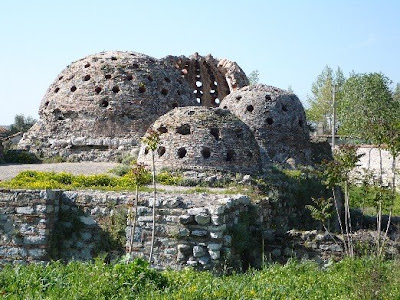 The Romans were my sort of people in that they always included a library as a component of the complex of warm, hot and cold rooms and pools. Keith was in his element taking photos for his cat file, with many half grown kittens curling around his legs.
 The mosque of Isa Bey Camii was built in 1375 by the Emir of Aydin. It includes some pillars and items from other buildings and has a cleansing fountain in an enormous walled and garden filled courtyard. We entered the newly renovated mosque which is beautiful in its design, decorations and exquisite multitude of Turkish carpets.
 Here we met a Sydney woman, Lynda, who was to be our companion for the afternoon.

 Lynda was expressing some alarm, since we seemed to have been kidnapped and language difficulties prevented us asking about what was happening. When we alighted, they unlocked a gate and indicated that we should go inside. We were not alarmed, being more used to country friendliness and understood at once that we were being offered refreshments. After examining the two varieties of goats and their feed (mostly clover), we sat down to glasses of wine, and green plums presented by the boy. Lynda had a dictionary and looked up some words that helped in starting off communication. The father had a tiny bit of English but went off to tend the goats, leaving us to be entertained by his cousin and his son.
 Once again, the will to express friendliness and respect and to share information overcame the language barrier and we chatted and drew pictures together for nearly an hour. Meanwhile Keith and Lynda were discussing Lynda’s life experiences in English, which was a bit awkward for Keith because he felt rude if he listened and rude if he didn’t. The father returned and presented us all with branches of lilac blooms. The cousin invited us to visit if we came to his area and explained the bus system to get there. They guided us to a path through the orchards, which eventually led us to the road beside the Temple of Artemis.