Keith and Christine would love to hear from you with questions, comments, personal news and any news at all from Australia or wherever you are. We will reply to all emails! Please write to either windlechristine@gmail.com or windle.keith@gmail.comThis morning we woke up early and packed, took the bus to a stop not very near the new hostel and walked for ages until we found it. Our relief was shattered when no-one answered the doorbell and it appeared deserted. Time was rushing by and we were due to meet Alan at 9 o’clock. Keith stayed and I set off for the station, where I saw, from some distance, the familiar and dear form of Alan, sitting on the steps and scanning in the opposite direction for us. Together we retraced my steps to find Keith. Meanwhile the impenetrable door I had left Keith at, although at the address given on the Internet, was not the one we needed. Confusing. In fact the hostel was in a student residence in a different building some distance behind, and it was only because some other backpackers tried their luck behind the building and didn’t return, that Keith, carrying two big packs and two smaller bags, staggered around to find it. There were no clear signs showing where the hostel was.
We hadn’t had breakfast, and Alan had eaten ages before and had been out and about in Ljublijana since 7 a.m. so a café stop was required, with our early start dissipating fast and the heat climbing into the mid thirties. Ljubljana is a charming city, the capital of Slovenia. The population is only 276,000 so it is a comfortable size and has a heart of historic and interesting buildings with the River Ljubljanica curling its way through the centre. Supposedly, Jason and the Argonauts were zipping off with the Golden Fleece and they sailed into the Ljubljanica, where they encountered and slew a terrible beast, now known as the Ljubljana dragon. The dragon is in the ancient coat of arms on top of the castle and also features as four large statues guarding one of the bridges over the river. That bridge also has griffins holding up the lights and snarling at the passers by.


After breakfast we wandered through the oldest part of Ljubljana at the foot of the hill, looking for a way up to the castle. The building facades hug the road, whose path is defined by the curve of the river only one block away. Always a city where migrants from other countries made their homes, there is a touch of Italian and Austrian influence, and a great mix of styles. The streetscapes and roof scapes are very interesting and eye catching.


We passed churches whose onion-shaped domes, usually in green, rose above the terracotta tiles of the surrounding rooves. We didn’t enter any on this day, but admired their facades and the statues in the squares near them. The path to the hilltop was not at all challenging and we were soon at the castle entrance. The hill was occupied from very early days, with fortifications having been built long before the time of the Romans. The Medieval castle was originally built in the 9th century but was restored and changed after the earthquake of 1511 and with restorations in the 17th century.

Alan asked us if we had been concerned about earthquakes while we were travelling, and Keith said that he had been quite conscious of the fact that we had been in many earthquake-prone areas and a little concerned, and that the histories that we had learnt showed how unstable everywhere was. I had read all about earthquakes but not connected them to the present or to me at all. Also I am in ‘non-worrying mode’ for this year.
Originally lived in by provincial rulers, the castle became a garrison headquarters and then a prison, and now, after recent renovations, it houses a wedding suite, a restaurant, exhibition spaces and other commercial and social venues. As such, it was quite different to all the other castles we had visited and, while a great venue, as a castle it seemed to have sold its soul. This impression deepened with our visit to the tower, for which we paid to climb a short spiral staircase in a renovated tower from which we did have a fine view, although not significantly better than the one from the hilltop.


Added to that was the bizarre ‘Virtual Museum’ visit in the tower, paid for of course, where we wore 3D glasses to watch a tourist rave promotion video about Ljubljana. I took my glasses off for a while to see the difference and there was not much other than a slight blur, and not much point wearing them for such a film. Once I had got over the idea that this restored castle was now a commercial business, I was able to appreciate seeing what it used to be like. We visited various exhibitions, none of which were related to the castle’s history and could have been anywhere. The first was a design exhibition in a tower, with the drawings and models being designs which cater for people in a variety of built up environments. It was interesting to see the innovative ideas which, in some cases, utilised more than one level, and I know through our daughter Holly’s experiences in her course, that they represented an enormous amount of research and application. Keith and Alan had been in and out before me, but they both accepted that I would be lagging behind. The walls were painted with monochrome pictures, almost like cartoons and depicting many scenes which I presume told of the history of the area. There was no information about them but they seemed to be of considerable age, since they were damaged, and the subject matter related to Medieval life, with a large section on hangings, burnings and witch hunting.
A sad looking teen was on guard for an exhibition about traditional weddings, which showed the clothing and presents that were given. The girl brightened when I asked about the ‘yoke of matrimony’, a joke present given to the groom which appeared to be missing, and it was probably her one moment of human contact in the day to tell me that it was in fact hanging on the wall, nowhere near its label.
The next exhibition was highly entertaining and was a photographic diary of the television program in which couples competed to be the top couple of their nation and to be married publicly with great celebrations. I missed the basic premise of this contest, which is whether the couples were already married or were planning to marry, but every region and some other nations had entered to see if their couples would win the public vote for their efforts in contests involving the traditional skills of married people. (Not quite all the important skills of married people were put to public test, as the following list will reveal). They toured the country raking hay, putting cradles together, singing, dressing baby dolls and completing tasks set to pay for the bride, and all the while amassing telephone votes (or not) until the winning couple were chosen. The actual weddings in Ljubljana involved the whole population in days of festivities and free food as they celebrated with the lucky couple.
Alan had exhausted the capacity of the souvenir shop for entertainment while he waited, and now lazed in the shade. The temperature continued to rise, but we decided to go on a walk to a hillside on the other side of town. The forest on it had looked so inviting and so uncommercial from the top of the tower. It was a pleasure crossing town and gaining a sense of the winding streets, the promenades along the river, which were designed to provide relaxed and beautiful surroundings for the inhabitants by the architect, Jose Plecnik, and the spectacular buildings and sculptures. We crossed the three bridges, which is a pretty complex of an original wider bridge with two narrower ones at the sides. All of them have decorative stone fences and are nearly side by side. In front of us lay a square named for the greatest Slovene poet, France Preseren. A statue of him with his muse, a beautiful woman in drapery leaning over him, was dwarfed by the magnificent cathedral and the other buildings nearby. If I hadn’t previously known about this statue, I might have thought that the muse was about to assault this most august poet.

We didn’t stop to examine everything; we would return another time. For the moment sorting out supplies for lunch, finding the place where Alan had been told he could get the walking map we would need for the next day’s excursion, locating the Modern History Museum and walking in the forest were our priorities. The supermarket really was a ‘super’ market, not the small shop with the big name that we had become accustomed to. It is amazing how having more things in front of you prompts more purchases, so we had a better picnic than usual. The park where we ate was one we had passed the day before and it was interesting to see the progress that had been made with the new sculpture, a community of tall, thin, upright stones, each with a design like doodling etched onto it. The clan had increased and the workmen, like us, were lazing under the trees enjoying a break. The service station did not have the map we needed for Bled, but they would be available there so we weren’t concerned. As we turned away from the city, Alan pointed out the road signs, which gave the left and right options as Austria and Italy, with only the straight arrow keeping you in Slovenia. It brought home the size and position of this country, which is considerably smaller than Victoria, and was something that could never be seen in the one-nation continent of Australia.

Slogging along the pavement in the heat, we at last came to the Modern History Museum. We braved its gun out the front and discovered that it was closed because it was a national public holiday for Statehood Day. Normally this would have been bad news for me, but along with the others, my brain had been frying for some time and the lure of a shady forest was strong. And it was just what we needed – natural but with a defined path, cooler and shady and very beautiful.

At one stage we followed an arrow leading to a specific place but the fact that we never get there didn’t bother any of us. Alan was able to tell us the names of all the trees and plants and we enjoyed both walking and relaxing on a bench.


All the time we had been chatting about our various travels, with Alan having attended a conference in Italy and being on his way to visit our nephew, Gregor, in Berlin. Earlier in the year Alan had travelled to Cuba, so there was a lot to catch up on, quite apart from the family news. Alan is such good company and we really enjoyed the day. It ended with a glance into the European version of a $2 shop called a ‘Euro Cent’ shop, a slightly cooler walk back and drinks on the terrace of Alan’s hotel.
Crossing over the river, paying our respects to the dragons and hissing at the griffins, we arrived at our hostel at a reasonable hour. The flat we had hoped to rent for four weeks in France had fallen through and we now started a search for alternative accommodation, using an Internet link from Joel, which was to be fairly fruitless and I gave up after 11 o’clock. Only one place appealed and maybe was available, and I wasn’t sure if it would be OK. It was a horrible, hot and sticky night, so I doubt if going to bed early would have been useful anyway.


Ljubljana has a sophisticated network of cycle paths which, wherever possible, separate the cyclists from the motor vehicles. Major intersections have separate signals for cyclists.
 Keith and Christine would love to hear from you with questions, comments, personal news and any news at all from Australia or wherever you are. We will reply to all emails! Please write to either windlechristine@gmail.com or windle.keith@gmail.com
 Alan had tossed and turned all night in the heat too, but we were off to Bled so we were all in high spirits. It is world famous as an alpine resort, but we found that it was the ideal combination of tamed and wild environment for a sunny summer’s day.
  Two very friendly tourist information people set the tone and we set off to visit the castle, high on a rock overlooking the lake. The pathway there wound through some stretches of forest and at last we saw a squirrel - the most enchanting little creature, peeping at us around a tree trunk and looking like a very intelligent and not overweight stuffed toy. I had been sleeping not more than five centimetres from his relatives when we were in Bosnia but I had never caught a glimpse of one of them then.
 The castle itself looked just the part, and was set on the hill so that it would be impenetrable and it still was if you didn’t want to pay 3.5 Euros to enter (Au$6).
  We decided to wait and ask some people when they came out, and the verdict was that the view was very nice and worth it. Not to us, who would be climbing a mountain and would have our fill of free views, so we circumnavigated the hill top and then climbed down to the path around the lake. Really a clean lake is just the best thing, and clearly a few hotels and businesses thought so too and had fenced off parts to add slides and amenities to, all at a cost. But at Bled the lake doesn’t need anything other that the shady trees, the many inlets and clear swimming patches, the ducks and other water birds, the teeming schools of fish near the banks and the stretches of lawn to laze on with a book. We had lunch in a beautiful spot where springs bubbled up around our bare legs, cooling us off.
 Nearby there was a list of regulations that seemed extreme, and included no swimming, no shouting, no washing cars and no riding bikes. The citizenry were all out disobeying every one of the rules except the car washing one, and it would have been a brave municipal officer who tried to enforce them.
 Our climb up the mountain was fairly steep and on tracks which were obviously running streams when it rained; we even found frogs on the path. Many birds called and we noticed different plants and took lots more photos of flowers.
  At the top we had a view that on the commercial market would have been worth 1000 Euros at least – all around the lake and surrounds, to the mountains in the distance with streaks of snow still lying on them.
 We stayed there for some time, drinking it all in, and so glad that we had climbed to see it all. The way down involved many steps and some near vertical sections, so it was very quick.
 We popped out of the forest at the lake’s shore and from then on I was really dying to have a swim. I had my swimming outfit but it was in my bag and to have a swim would mean two changes, without changing facilities. Finally I stopped to test the water and it was perfect, just not perfect for swimming at that spot. A little further on, opposite the church that crowns the island in the lake, we found the right spot with a stone wall for Alan to sit on and dangle his legs in, and partial cover for me behind a tree. Partial was the correct word so I needed to be speedy. Not so bad for changing dry clothes but it was to prove a challenge later when changing back, with a clammy body resisting the dragging on of clothes and pressure of a sudden influx of strollers on the path. But the swim was the best I have had for years – no waves, cool water, shade – and for me, no need to protect my eyes from glare so for once I had the opportunity to go underwater and to feel completely free. I convinced Keith that he should come in, which he did, but he was cold after a short time.
 At last one of the patient men was not so patient, and Keith suggested that I get out so that we could catch the five fifteen bus. I wish that we had arranged to stay at Bled so that I could have lazed around reading, taking dips whenever we got hot, and setting out on little explorations of the mountains and surrounding walking trails whenever we felt energetic.

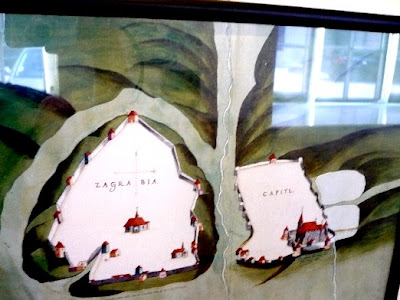 The Ottomans remained a threat from 1469 until 1593, and, although Bosnia was taken and remained under the Ottomans for centuries, the then Slavonia, of which modern Croatia and Zagreb were parts, were able to fend them off. Extending and completing the cathedral was then a major priority, with many renovations and reconstructions to continue throughout the centuries. A whole area of the museum was devoted to the items taken from the church at different stages. Hermann Bollé designed the most recent gothic restoration after the earthquake in 1880 caused enormous damage.

 The first guilds or professional and craft associations were set up in the fifteenth century, running as a group enterprise with its own finances, standards and provision for the widows and orphans of its members. By 1872 they had become an ‘impediment to the economic development of the city’ and were banned. Goodness knows what they were up to. Zagreb attracted craftsmen and all apprentices had to attend drawing school, which resulted in a very high level of artistic expression in even every day items. By the beginning of the 17th Century wars, plagues and fires had taken their toll and so had the annual bun fights when the election of the council was held. Instead of everyone having a say, some prominent citizens arranged for it to become a system of senators, elected for life, with twenty-two deputies who chose the mayor from the senators. Surprise, surprise – there was civil unrest, since the new system led to the creation of privileged families. King Mathias approved it all and in 1629 the new electoral ‘system’ was proclaimed in Croatian, following its original proclamation in Latin.
 The last Ban was sworn in in 1869. The 19th century was a time of modernisation with street lighting and public transport being introduced and developed.
 The late 19th Century and early 20th Centuries were times of great building projects, with the earthquake prompting some, and some careful town planning for the lower city requiring others. The population increased by 48% in the last decade of the 19th century to 57,000. On July 28th 1914 Austria-Hungary declared war on Serbia, and as part of the Empire, Croatians were called up and fought for the Monarchy. Zagreb Units fought on the Balkan front and, in the following year, on the Italian front. This means that Croatians, through no direct concern of their own, but under the command of the Austro-Hungarian Empire to which they had been attached since the Middle Ages while under Hungary, were fighting their immediate geographic neighbours, Serbia and Italy. There were extreme food shortages for the troops and the people in Zagreb, with rationing and ‘meatless Tuesdays and Fridays’ being introduced. Bells and roofs were taken from churches to provide the raw materials required for the war. There were some military successes, but also many casualties, with streams of wounded and the starving from Bosnia stretching the capacity of hospitals and charitable organisations. When Emperor Franz Joseph died in 1916, the Austro-Hungarian Empire effectively ended and, in 1918, the Hapsburg Monarchy collapsed and the Yugoslavian Union was created as a kingdom. Its members had geography and some language in common, but religion and historical connections to other Empires and countries as differences. Some had just fought against each other in the war. Croatia as a nation ceased to exist.
 Back at the flat we said farewell to Vladimir. He had been a kind and helpful host and we had enjoyed many interesting discussions with him.
 More signs of being very much in the west and leaving Eastern Europe behind: mechanichal street cleaning, pet dogs, prams for babies, and expensive motorcycles.

 The Inverleigh Historical Society's 18th Century document storage chest appears to have found its way into the Zagreb Museum collection.
 We were off to the Miragoj Cemetery, my choice of the sites since visiting cemeteries is one of my long term interests. I am used to the cemeteries in Victoria, in Australia, and in particular to country ones - where a pair of gates and a fence is all that is required to hold in the sections for the different denominations and belief systems. This one, however, was architect-designed by Hermann Bollé and is lavish in every way. We walked up a long hill to reach it in 35 degree heat, so I was cheered to see some stalls that looked like drink stands in front of the high walls with green cupolas on them. What a pity they only sold coloured plastic vases of pelletised wax to place as lanterns on the graves, and flowers.
 To each side there are arcades with domes and patterned tiled floors. Wealthy, notable and famous people have tombs along the arcades, with sculptures and tomb stellae against the walls and access to the tombs in the tiled floor. The variety of sculptures and their size is stunning - it is like being in an art gallery as much as in a cemetery. Some sculptures are religious in nature but many were not, denoting the interests of the deceased or the grief of the mourners. Political leaders, such as the presidents, were grouped together, and had wreaths on stands in front of them. There is a strong awareness of the contributions of some leaders and often flowers and lanterns are left there for them by ordinary citizens. It was interesting to note that in this predominantly Catholic city, there were some Jewish graves up in the arcades.


 Beyond the arcades, trees shaded the paths and graves, which seemed to continue endlessly down the hill.
  Here the statuary was a little more discreet, although now and then a whole chapel, with full altar and religious statues, rose amongst humbler graves. Again it struck me how art is valued here and so was included for some graves, seemingly for its own sake and as a link to a loved one. One very poignant grave was of a family who had lost two babies and then a little boy of four years old. The photos of the parents and the little boy were on the grave and a statue of the child had been made and added. It was so like him and in a joyous childish pose.
 Eagles, uncut stone like the rocks in a mountain, two lovers’ heads entwined, a coloured mosaic of an angel, a golden statue of Baloković (a Croatian famous for his violin concerts, his wartime efforts to get relief to war victims and his support for the anti-fascist partisans) with his violin, a weeping woman, and a large relief of a couple arm in arm – the woman in folk costume with corn and the man with a rifle as a partisan – all expressed individuality and care.
  A mass produced head of Jesus with the crown of thorns lost its impact after seeing about fifty in a row, but probably was affordable. Some graves incorporated gardens with either plants that were hardy or others that showed regular visits and care.
 In the centre row, behind the church, a cross with Jesus on it was surrounded with many lanterns. They were placed there by those grieving the loss of loved ones in the six month war with Serbia in 1991.
  We were unable to read the inscriptions on the graves beyond the names and the dates, with often the title of professor or doctor added, but there did not seem to be the custom to add the names of others eg ‘loved daughter of’, details of the death eg ‘accidentally killed’ or an epitaph.
 Another man, not so lucky as to have a guarding companion, slept on a seat and I could see why after a couple of dogs had been over to sniff me and taste my discarded socks. In the park there is a sculpture vaguely resembling a head, which is a tribute an anti-fascist, Goran, who lived from 1913 - 1943. On the pedestal there is a soccer scarf, along with lanterns for the dead and dried up bunches of flowers. A lady exercising her dogs told us that a few months ago, the park was regularly frequented at night by young people who went there to get together and have a drink. One night a group was celebrating a birthday when some others arrived, and having no alcohol, they demanded that the first group hand theirs over. They refused. A boy from the second group tore a wooden picket off the rubbish basket and threatened the others. A knife was pulled out of a box by a boy in his early twenties from the first group. Minutes later one life bled out on the grass and another was ruined with prison and the emotional aftermath of having killed someone.
 The tributes to the dead seventeen year old continue to be placed and the woman watches young people come and spend time there, praying or just thinking for a while. The park behaviour has calmed down, but for how long, nobody knows. Some say that poverty has driven young people to leave safer social venues for the parks and streets, where there is nothing to do but drink.