Thursday, June 26, 2008

Zelenkovac, Bosnia, to Zagreb, Croatia, Friday June 20th

Keith and Christine would love to hear from you with questions, comments, personal news and any news at all from Australia or wherever you are. We will reply to all emails! Please write to either windlechristine@gmail.com or windle.keith@gmail.com

It is interesting how it takes a little while to adjust to the rhythm of life that each move brings for us, as well as to the places and people we encounter. From arrival, when we wonder how to do things, to the moment of leaving when we have just got a handle on how things run and are learning about the people, it is all too quick on this trip.

We learnt that everyone in Bosnia has a history, both long term and short term, and that the war may be over but its impact is not. People’s lives are deeply affected by losses, by acts of atrocity that they witnessed (such as the killing of a wife in front of husband and child), by wounds (such as those that resulted in plates in a head and bodily scars from being shot), and by continuing hatred and suspicion. Education deals with history selectively, according to the teller’s background. The area we were in was an ‘entity’ called the Republica Serbska. Mostly Serbs live there but politically it is part of Bosnia. No-one seemed able or willing to explain this anomaly of a border without a border, of a kind of state within a state, of allegiances that are strong but maybe not to Bosnia. Admittedly for the people here, their explanations are adequate because they have all the background knowledge but we are still very confused.

It took all our time to eat, pack and clean our room before we were farewelling Clare and T who were setting off to hitch hike, and then thanking Boro for having us before we left to catch the bus. This is a wonderful place and Boro has lived his vision, creating a heritage to share with others. He has many ideas to move forward, taking it slowly and working within the restrictions of environmental knowledge and practice in Bosnia. We gave him a donation towards the development of Zelenkovac. We would urge any readers coming this way to consider coming to visit – it was a real privilege to come here and we would be keen to come again.

Following a 400 metre walk to the road, the bus picked us up in response to our wave, and we were on the way again, this time to Banja Luka, still in Republica Serbska, in northern Bosnia, to change buses and then to Zagreb in Croatia. The wait for the bus allowed Keith to check the internet and then to use Skype to phone Vladimir, who we hoped would still be able to host us. His ‘Yes’ had been for a different date and we had not heard from him since we sent him the change of date in an email. We were thrilled that he said ‘Yes’ and agreed to meet us at the bus station.

The walk to Vladimir’s house past a park and up a row of identical looking communist era blocks of flats was not long. He is a teacher of German, and keenly interested in history and his country’s heritage. We talked about the situation for Croatia in the 1990s, when it had been attacked by Serbia after declaring its independence as a nation. The war lasted six months and ten thousand Croatian lives were lost. Serbia had been dominant in the Federation of Yugoslavia, and had asserted its control over the army to try to retain Croatia in some kind of union. Croatia had always been connected to Western Europe, having being ruled by the Hungarians since at least the ninth century, and later by Austria-Hungary. It was only in the 20th century that it became part of Yugoslavia and connected to the other Balkan states in that federation.

After a light supper and a drink, we settled in to my dream room – a whole wall devoted to a library of history books, all used and some written by Vladimir’s father who was a history professor at the university. What a pity I could not read even one word of them, but it was a décor to lull me to sleep beautifully.Reminders of the war are still present in many parts of Bosnia.Signs of leaving the east and entering western Europe: mowing grass near the border between Bosnia and Croatia; the first sign of parking meters since we left Australia in January; and large advertising billboards attached to city buildingsa Zagreb tram

Zelenkovac, Bosnia, Thursday June 19th

Keith and Christine would love to hear from you with questions, comments, personal news and any news at all from Australia or wherever you are. We will reply to all emails! Please write to either windlechristine@gmail.com or windle.keith@gmail.com

After a full day on the outside line our washing hadn’t dried and we hadn’t mastered the vagaries of the shower – scalding hot or cold. We were not fussed and since we were mostly communing with nature and others in a similar situation, we just put the same old clothes over the same old unwashed bodies and started the day. Keith was desperately behind on the blog photos – about twelve days - and I was about a week behind on the text, so we decided to devote some real time to catching up. I went down to sip tea, chat and read my murder mystery in French while Keith had a turn on our computer. We have a tiny, lightweight Toshiba laptop, purchased second hand for the trip and it is a gem. The morning drifted by with lots of progress by Keith and only a vague understanding of the novel characters and their motives by me.

At twelve o’clock we set off for a ten kilometre walk out of the camp and into the hills on the other side of the road. The forest was dense so we stuck to the road that led to the upper part of the village. It was such a pity to find an informal but regularly used rubbish dump by the side of the road, spilling down into the valley.

Everywhere else the air was fresh and there was beauty all around. In fact, it felt a little like being in a Thomas Hardy novel, since so many rural tasks are still performed by hand.

Little hay stacks were being added to by the forkful, men and women were bending from the waist weeding in the crops and the lanes were full of cow pats from small herds being walked between pasture and milking shed. The houses were mostly white cottages with red tile rooves, surrounded by rustic out houses and stables. I was thinking all this when we came to an old woman raking grass and stacking it in a wheelbarrow. She looked at us as if we were from outer space, and we wondered if we were in fact on her land rather than on a road. All the buildings could have been one farm, with the man chopping wood and the child peeping out from behind the house, since there were no fences at all. We asked her if the road we were on would lead us up the mountain, and she said something which we couldn’t understand. What to do then? Maybe she said no and then that would look silly to proceed. Maybe she said yes and it would be silly to retreat. Maybe she told us to get back to Mars and off her land. We went forward, with her amazed stare boring into our backs. It was not the road to the top of the mountain and we soon had to walk back past our informant, who stared at us again, no doubt considering us to be complete fools.

We were cheered by meeting a gap toothed farmer with whom we spoke no common language but who was able to make a friendly meeting out of using one word to ask if we were German – “Deutsch?” – and who then continued with smiles and other country and language names. He was a sweet man and a treasure, although his cleanliness was even worse than ours. Shortly we came to the start of the village proper, where it seemed that a travelling rural salesman had had great success in convincing every person to have a brightly coloured painted cyclone fence. Maybe it was a case of keeping up with the Joneses. Soon we came to a large house with beautifully manicured lawns and virtually no vegetable garden, and flowers in shaped beds. It had a bitumen driveway (and of course a red cyclone fence). We joked that it must belong to the mayor since at this point the made road also started.

The houses in the centre of the village had areas for milking, vegetable plots and fruit trees. It was very picturesque, with the hill dropping away to the church and lower village, a horse and cart winding its way past a paddock where an old man raked hay by hand and presumably his grandson was using a tractor for the same task.

Always hungry for contact with the locals, we entered the café for a drink. Two young men eyed us for a second as we entered the deserted rooms, and then turned back to the intrigues of the soap opera on the TV. We went through to the room with the bar and tables where we were briefly joined by one of the young men who took our order, served it and retreated. We were forced to socialise with each other and to admire the décor, something that combined red and orange vinyl covered furniture, a picture of a hunting scene, a set of home-made dumbbells with fruit tins filled with concrete and a moody looking black bar.

Cutting our losses, we took the low road past the church and then went shopping. It was very tempting to bait the sales woman with smiles and friendly gestures but her demeanour clearly suggested that our purchases would be cancelled if we required any change in her facial expression.

Clare was back and T was having lunch and then was busy with the barman and guests. Clare, Keith and I had a late lunch and then settled back to some photo sorting, chatting and reading. Alex joined us from time to time and when Clare and T went off for a walk to the village, I discovered that the criminal in my book cannot stand the sight of blood and always strangles his victims with a silk scarf. Such are the levels of excitement in this tranquil spot.

Keith and Clare heated up the dinner and made some fried bread. Meanwhile T and I were chatting to the people who had arrived at the bar. One man described his cousin as his brother and it turns out that the brother/sister relationship is conferred on first cousins as well as children of the same parents.

Clare, T, Keith and I had a lovely dinner together, a bit of a last supper since we knew that the next morning we would all go our separate ways. Alex was not eating with us but joined us and nibbled various items in a companionable way. He is a lovely boy, very friendly, articulate in English and a deep thinker.

All was quiet when we went to bed and now I worried that something had happened to our squirrels. During the night we heard heavy footsteps coming up our ladder. Someone opened the door to come in but Keith called out that we were sleeping there and they retreated, apologising I guess. On balance, I would settle for the squirrels any night.

Zelenkovac, Bosnia, Wednesday June 18th

Keith and Christine would love to hear from you with questions, comments, personal news and any news at all from Australia or wherever you are. We will reply to all emails! Please write to either windlechristine@gmail.com or windle.keith@gmail.com

The rhythm of days is slow for us here – sleeping late after a latish night, a little typing until the need to go to the toilet (behind the gallery and some distance away) overwhelms all other thoughts, picnic breakfast and maybe a cup of peppermint tea (purchased at the bar), sitting around chatting, a major walk in a new direction, late lunch and wondering where Boro is and whether the tasks around the place we had volunteered to help with would happen today, more sitting and chatting, some reading and typing or photo sorting, perhaps another walk – a lazy routine in a beautiful place.

Today’s walk was behind the camp and up the mountains. The higher we went the less undergrowth there was until, at the top of a hill, we were able to walk easily between the trees, bouncing on the sponge-like accumulation of years of autumn leaves. We are back to photographing flowers – there are so many we haven’t seen or are astounded to see growing wild.

Boro had gone to town so, since our labour was not needed, we extended our walk down the road past the cemetery. When I was a child I had a book called ‘The Little Green Road To Fairyland’. Here it was in reality, a shaded tunnel of trees and flowers with the distance never visible because of all the bends. Moss and fungi grew on the banks, with mushrooms popping up like tiny homes near shiny black tree trunks. Water seeped out of the leaves covering the earth. A final bend revealed a paddock of flowers to walk through and then the (for us) endlessly fascinating vista of vegetable gardens as we approached the village. The village is spread out along a few roads, with one part lining the main road and another further up the mountain, beyond the Christian church that unites the two main masses of houses. In between crops flourish, hay is being baled and a few animals graze.

We have noted a lack of eye contact and interest in us, more of a neutral stance, and it continued here in the shops. If we could work out what we wanted and find it, we were fine, with the amount needed shown to us on the cash register. If we needed help, it was not very forthcoming. Language is a big problem for us, and although we thought we learnt no Turkish, we could understand a bit and read some signs and also speak a little. With no words at all, we can’t even begin to set a friendly tone. We discussed language and lack of language with the Clare and T and we all feel that it is more to do with the will to communicate than with actual vocabulary. A lot can be said with gestures and body language but you have to want to go out of your way to put in the effort for it to be successful. Still, we were able to buy supplies for dinner and breakfast and some treats as well so the actual shopping part was achieved.

We found the cook and borrowed the key to use the little kitchen. He never seems to use it around our idea of meal times, which works out well for our cooking. We made lentil and vegetable soup for the four of us, expecting Clare to return from Banja Luka, a city a couple of hours away, where she had gone for internet access. It is a dial up system here and the cost of a long distance phone call every time you use it, so not really viable other than to check essential emails. Couch surfers always need loads of time to research accommodation possibilities and to write to and negotiate with potential hosts, as well as replying to emails, so Clare had gone off in search of an internet café.

Clare did not return, so we ate anyway and later T heard that she had had to stay over in Banja Luka. Clare and T met through their couch surfing hosts and decided to travel together for a while.

The squirrels must have been having a party, or perhaps for the first time I was not tired enough to sleep through the racket. At one stage I was sure that a small creature was walking on my back and after that it was difficult not to anticipate a repeat. In the morning I realised that I probably dreamt it all, but in the dark I had certainly been convinced and lost some sleep.

Our hut in the forest at the Valenkovac camp.
Above: an old mill wheel sits where the stream used to be carried to it by a timber race. The wheel would be turned by water power and inside the millhouse the mill machinery would grind grain into flour.
More buildings close to the camp.
A farm house on the way to the village from the camp. In the background is the church tower.
The main road in the village two kilometres from the Zelenkovac camp.

Wednesday, June 25, 2008

Zelenkovac, Bosnia, Tuesday June 17th

Keith and Christine would love to hear from you with questions, comments, personal news and any news at all from Australia or wherever you are. We will reply to all emails! Please write to either windlechristine@gmail.com or windle.keith@gmail.com

We woke late and lazed around over a cup of tea, not sure about the breakfast routine. Eventually Boro emerged and we were to look after ourselves. That was the case for all of our stay, since the menus there were all meat based and the cook planned and prepared ahead. It was no problem since we had supplies and there was a village shop two kilometres away. Claire and T ate their evening meals with us, with Claire as assistant cook and T a willing cleaner upper.

The routine of the days was a leisurely start in the sunshine, then the arrival of bus and car loads of visitors who had come to spend the day here, walking and having picnics, and usually frequenting the bar. Boro and his family addressed one tour group on the aims and achievements of the camp, and afterwards a lady came and asked us four couch surfers if we were artists. What a pity we were not, and if ever there was a place to inspire you, this was it. It is important to the survival of the project that people learn about it and support it by visiting and spreading knowledge of it to others. There is also a business aspect in the running of the bar and in letting out the bungalows to tourists. All in all, it has grown well beyond one man’s retreat from the rat race to follow his art, and Boro is pulled in many directions at once.

We could only speak with Boro, his son Alex and the other couch surfers due to a lack of common language, but the workers were friendly and basic communications worked out OK. We didn’t know how they had come to be there, but we knew that the barman, Jayko, was a very talented artist, since his paintings of women and buildings were on display. He was always busy with his bar work so it is hard to know when he painted, although in some seasons there would be less visitors.

Our first walk took us through along a track edged by wild flowers, so profuse that visitors regularly carried home great bunches of them. The forest loomed above us, often turning the path into a tunnel. Different birds called to a background of the sound of running water. A puddle was the venue for every part of a frog’s life cycle, as well as for a small lizard like creature that wiggled as it swam and came up every five minutes for a gulp of air.

We came to a Christian cemetery, one used since ancient times as shown by the crosses deep in the soil, with some practically buried. The headstones were of a type we had not seen before, of granite with a photo of the deceased somehow engraved into it. There were slightly more deaths for the war years, although still small numbers and some were of elderly people. It was quite different to the enormous cemetery in Sarajevo where people pause on the way to work to pray for loved ones, buried along with hundreds of others as a result of the war.

Following paths and winding up in fields of flowers, or stepping over a fast running stream to an abandoned orchard – it was a walk of exploration and wonder. After lunch we joined Alex, another worker, Claire and T to do some site works and tidying up around a barbecue area. It was a fairly small job for so many people but we had fun working together and the result was very satisfying. I was inspired to add to Keith’s return home list of jobs, with some nice little rustic areas to be built in our garden, but realised that the charm came from the lush and verdant forest backdrop and that a similar effect would be hard to achieve in a drought ridden flat back yard.

The day lazed away with chatting and relaxing, and with the preparation of the most tasty risotto ever. Suddenly it was ten thirty and time for us to set off for a night with the squirrels. The others stayed up much later than us.

Our host, 'Boro'

Our hut with the squirrels in the woods
Below: more views of the Zelenkovac site and the surrounding forest

Tuesday, June 24, 2008

Sarajevo to Zelenkovac (Mrkonjic Grad), Bosnia, Monday June 16th

Keith and Christine would love to hear from you with questions, comments, personal news and any news at all from Australia or wherever you are. We will reply to all emails! Please write to either windlechristine@gmail.com or windle.keith@gmail.com

We didn’t know anything about bus times so we packed, left our packs at the hostel and walked the three kilometres or so to the bus station to check times and buy tickets. We knew roughly where it was and just kept looking for buses and asking until we found it. We were lucky that a bus left in the afternoon and that we hadn’t already missed it. We wanted to go to Mrkonjic Grad, but the man in the ticket office said that we would have to go to Jajce, and take another bus from there. This seemed at odds with the instructions for getting there that we had received from Borislav, our next couch surfing host, but the language barrier was too great to get clarification.

We took a very crowded tram to the Sarajevo Museum 1878 – 1918, the one with the assassination spot outside. It explained that, at the Berlin Conference in 1878, Austria-Hungary was given the mandate to occupy Bosnia and Herzegovina. It is amazing that groups of countries could make decisions about others, but it has happened many times, with the other countries being awarded as spoils of war or simply being taken over. There was considerable resistance in Bosnia and Herzegovina, since a nationalist movement had already been active. The Austro-Hungarian Minister had said that he would take Bosnia and Herzegovina with ‘a company and the military band’ but it eventually took 300,000 troops to do it, such was the resistance. The room had various displays showing progress over the years from 1878, with industry, transport and power all being areas of great development. Many public buildings were constructed, the Bosnian Assembly was elected and met for the first time in 1910, traditional crafts died out or adapted to new western expectations eg fez maker to hat maker, and there was a multicultural mix of Muslim, Christian and Jewish people. Interiors of rooms changed from the Turkish style with built in cupboards, shelves and seating, to western style rooms with chairs, sofas, beds and other furniture that could be moved around. Rich people changed over sooner than others, who would combine the old with the new, perhaps in the form of one western chair added to the existing scheme.

A large part of the exhibition is devoted to the assassination of Archduke Franz Ferdinand and his wife, Sophie, the trigger for WWI. Excerpts from the general exhibition film made about the events showed a glamorised version of them arriving at the station to a crowded welcome, of driving through the streets towards the City Hall, of the first failed assassination attempt being made with a bomb, of them bravely proceeding with their itinerary of the reception at City Hall and of the final moments when they are both shot by Gavrilo Princip. This was mixed in with actual footage and photos up to one second before the assassination. There were so many opportunities for the assassins, since the royal couple were travelling in an open carriage with their bodies from the waist unprotected even by the vehicle. The seven in the plot were arrested, a large funeral was held in Sarajevo and the bodies taken back to Austria for burial. After the shootings Serbian property was destroyed, with many photos showing people destroying furniture, and dwellings – whatever they could get at. Presumably this was done by those loyal to Austria-Hungary or, as seems to happen, by those with other interests or scores to settle who take advantage of unrest. A Serb told us that Austria-Hungary was looking for an opportunity to attack Serbia – we simply don’t know enough and will look up what events led up to this moment and what happened next, to draw so many nations into a world war. As Keith put it, a Serb killing Austrians ended up in Australians fighting the Turks, but obviously there are complexities behind that situation.

There were two mannequins dressed as Sophie and Franz Ferdinand, and Sophie, in her feather be-decked hat, bore a remarkable resemblance to my friend Val, when viewed from the end of the room. The real Sophie was not nearly so good looking and looked like she enjoyed pastries quite a lot. An extra sad note was that they left behind a young family and that Sophie was pregnant at the time.

We had time for one more visit so I chose a small Serbian church and museum. The museum had many vestments with the most amazing embroidery – the stitches so fine that you had to peer closely to see them. There were treasures such as icons and silverware from the 17th century on. It was interesting to see the way icons have maintained a set look up until the present day, but there are developments in proportion and depictions of bodies and robes. Most expressions on the faces are just garden variety holy, but there was one 17th century Pieta that showed Jesus looking incredibly peaceful and Mary, so sad and lost. If you look into icons, some are strange, such as the one showing Mary in the clouds with one foot on a crescent moon and the other on a snake that is winding around and looking down, its forked tongue out. Two angels, disembodied heads with wings, look on from the corners. It was called ‘The Annunciation’. This is when a good knowledge of religious symbolism would help. A lovely 18th century icon of Mary and baby Jesus enthroned in the clouds, had him as a tiny adult, clutching a blue ball. Could this have symbolised something, or could the painter just have put in something that a child would like?

We entered the church of St Michael, the Archangel, built in 1539 and the oldest Serbian Orthodox church in Sarajevo, through low, solid, wooden doors. There was low lighting, protecting the icons but a tour group happily flashing their cameras at them. It had a central section with an altar and seating for the three priests who would officiate at a service and no chairs, since the congregation would stand in a circle if not elderly or infirm. Columns partially enclosed it and formed an outer corridor around it.

We were lucky enough to be able to listen in to the tour leader’s talk in English and it was fascinating. The carved decorations surrounding the icons at the front were embellished with real gold. The piles of grass in several spots are a traditional part of worship with branches and leaves being added at Christmas. There were separate spots for men and women (usually different sides), but in this case the men are on the ground floor and the women are on the balcony. Women cover the heads, something which the guide reminded the American crowd, was done in Catholic churches not so long ago. Serbian Orthodox churches in the old world have people standing and in the New World, their congregations are seated. There are also separate entrances. The wall colours of blue, yellow and white are common in temples built up until 1900 and are the Serbian state colours. The two wells for candles are one for the dead and one for the living. There were also two altars, one in the centre and one in a corner of the outer corridor. Some saints are common to all Orthodox churches but others are local saints. This church has many relics that look like little pieces of bones and they also have the whole hand of a saint (whose name sounded like St Etwa) in a silver mesh glove. She had lived in Syria but died in Greece. There was a record like a calendar, telling which day it is and which saint is special for that day. There was also a pile of money and the guide explained that it was considered that there needs to be a bridge created between a human and the Holy Spirit when asking for help, guidance etc. The bridge must come from the earth and has always been represented by metal, which is mined from the earth and usually with money. The money ensures that the message gets through, although the guide said that it was a good source of revenue for the church. The evolution of the church was that, after acceptance of Christianity, there was the Church of Rome, demanding taxes and condoning statues but condemning icons. The Byzantine Church split off, retaining icons, and from that the Orthodox Church evolved. The Serbians were the first to have an independent Orthodox Church, with internal power. The church leaders have historically played a big part as community leaders and in decisions about wars and major issues, and continue to be represented in the Serbian Government.

Keith went back to the hostel for our bags while I checked the internet and, discovering that we may need to cater for ourselves at our next destination, bought some basic supplies. The crowded tram was not the best for carting big packs but we managed, and luckily the tram went nearly all the way to the bus station. Every country has different procedures, with the Balkan countries requiring you to buy a ticket for yourself, to pay for each piece of luggage and to buy a token to get through the turnstile to the area where the buses are. At last we were on our way, with no idea of where Jajce was, except that it was somewhere north of Sarjevo, in the same direction as our destination, Mrkonjic Grad.

At one of the stops we showed a little diagram of the towns and our destination to the conductor, and an English speaking man helped. It turned out that we had taken a Bosnian bus in Bosnia, but that Mrkonjic Grad was in Republic Serbska, a part of northern Bosnia allocated to Serbs. The bus wouldn’t stop there, but would be passing within a kilometre of the town. It could drop us off on the side of the road and we could get a taxi for the last twelve kilometres to Zelenkovac, the home of our couch surfing host. Our helper was getting off there and he assured us that there would be no problems and that he would assist us. We paid the extra amount and thanked our lucky stars that this man was on our bus and we had avoided a possible long wait or overnight stay at Jajce. Further on in our trip we met a Bosnian, now living in New York, who we chatted with us about his and his country’s experiences. His family had left because of the war, had spent months in a refugee camp and had gone to America because it was the first country to offer them a visa. We commented on a war damaged house which he told us had belonged to a relative of his. A destroyed manufacturing complex had been the place where his father worked. He firmly believed that it was necessary not to dwell in the past but to look forward and to create the kind of future that would be good for everyone in the Balkans. It was a pleasure talking to him.

Standing on the side of the road, the bus diminishing as it drove into the distance, we were very grateful to our friend who rang a taxi for us.

A little while later we were on our way to meet ‘Boro’ (Borislav) and the group of people who live with him at Zelenkovac. Bosnia is a very beautiful country and Boro lives in part of it that is like paradise. As a young artist and poet, he had set himself up in a small mill of his father’s in the forest. The mills are little wooden buildings with grindstones in them attached to a water wheel, which is turned by a water race diverted from a stream. They are very small and many of them were usually set up near each other, as was the case near Boro. Over time he developed his mill into a gallery and bar, built bungalows in traditional country style and set up a community for like minded people who love nature and want to paint or create. He worked more and more on the environmental aspects and, despite problems with the municipality, has succeeded in having its support for his project. There is now a 30 hectare 'ecological zone' surrounding the camp.

Boro welcomed us in the bar and introduced us to the workers, to his family and to couch surfers Clare from Tasmania and T from America. We had a cup of tea and then went off to settle into a bungalow in a little glade about 30 metres from the gallery.

It was still light as we climbed the ladder to put in our bags, and easy to negotiate the bridges and streams on the way back to the gallery. There we chatted for a while and sorted out that we would be cooking for ourselves, were shown the kitchen by Boro’s son, Alex, and started work. The gallery is a cosy nook and cranny combination of spaces with all the tables and chairs being made from forest materials and a great stone fireplace in the middle. On every wall surface paintings, pastel works and drawings are displayed. An artist was drawing in a corner, the bar was hugged by locals, workers and friends and the atmosphere was decidedly laid back. Outside it looks like a building from a fairy tale, and in fact the whole forest and the little huts and houses, the flowered open spaces that you come suddenly upon, everything could be in a story. The evening’s discussions ranged over many topics but was particularly interesting when Alex, who was born at the end of the war, talked about its impact now. He said that there are deep schisms between the three groups of Serbs, Bosnians and Croatians, with each being taught their own versions of recent history and their own groups to hate.

It was not so easy to find our way to bed in the pitch dark, but, by allowing our eyes time to adjust, we managed. We had not settled in for long when we heard some thumping and the scurrying of little feet. Too tired to care that it was right next to my bed, I fell asleep. We found out that it was squirrels on the roof, and apparently in the gap between the logs and the wall linings. They were to carry on every night of our stay but we were never lucky enough to see them.

One of the short bus breaks was a lovely spot in the beautiful countryside, but there was a little surprise to be found if you went close to the river bank. Unfortunately this is typical of almost everywhere we have travelled so far.

Below: more countryside in northern Bosnia
Reminders of the 1992-95 war are seen frequently in the Bosnian countryside.

Sarajevo, Bosnia, Sunday June 15th

Keith and Christine would love to hear from you with questions, comments, personal news and any news at all from Australia or wherever you are. We will reply to all emails! Please write to either windlechristine@gmail.com or windle.keith@gmail.com

After breakfast we set off to do the day walk of the old town. We started with the History Museum, which we reached after a long and fascinating walk past many very decorative buildings, some of which had statues and faces on them, as well as colour contrasts and stonework. Many of the buildings have been restored, but there are still some, damaged in the war, that are boarded up awaiting repairs, or which still operate despite war damage. Bullet holes riddle many facades. We were intrigued as to how a community recovers and moves on, and not clear on how the war came about.

The ground floor of the History Museum presented a chronological history of Bosnia until the present day, with accompanying information sheets in English. We read carefully but still had some confusion because the terms used were unfamiliar to us in the sense that we don’t know what the implications are. An example is ‘annexed’ – what does that mean for the countries involved? Nevertheless, the following is a bit of a summary, as I understood the information.

Bosnia was a medieval state in the 11th and 12th centuries, and the territory grew under the reign of Turko 1 who ruled from 1353 – 1391. The Ottomans arrived in 1463, beheading the last Bosnian king and made Bosnia a ‘Unit’ of the Ottoman Empire, but maintaining the Bosnian territorial borders. Nationalist fuelled battles, led by rebels, spread across the country, with the result that Ottoman rule crumbled. The next bit is vague for us because between 1875 and 1878 there was fighting with Austria/Hungary, and at the Berlin Congress in 1878 Bosnia and Herzegovina entered the Austro-Hungarian monarchy. Not willingly though, for there were many resistance battles until finally the Austro-Hungarians took over. A national constitution was developed in 1910, and political parties and a localised government were formed. It was in Sarajevo that Archduke Franz Ferdinand and his wife, Sophie, were assassinated by a Serbian nationalist on June 28th 1914, which triggered World War I.

After WWI, the Austro-Hungarian monarchy was dismantled and Bosnia and Herzegovina became members of the Kingdom of Serbs, Croats and Slovenians and in 1929, members of the State of South Slavs Kingdom of Yugoslavia. There were attempts to break down territorial integrity but they were not successful. In WWII Bosnia and Herzegovina were a bit like pawns used to suit different political and military goals, with a national liberation movement led by Josip Broz Tito, forming the State Antifascist Liberation Council. There were demonstrations throughout the country with battles with partisans. In 1943 Great Britain, the Soviet Union and the USA decided to help the partisans in Yugoslavia. In 1945 Bosnian statehood was reaffirmed within the Federation of Yugoslavia, and continued until the collapse of the Berlin wall. During that time there was fifty years of reconstruction from the massive war damage to infrastructure, buildings and the economy under a socialist system. The first post war multi-party parliamentary elections were held on November 18th 1990. The legal fight for international recognition of Bosnia and Herzegovina as an independent state began. This was finally given on 6th April 1992 and resulted in the war, started by Serbia, whose aim was to divide Bosnia and Herzegovina and to join them to Serbia and Croatia. This is difficult to understand, but is further complicated by the fact that people from all the ethnic groups live in Bosnia, and there were concerns for other groups if independence was achieved. A plebiscite of Serbians living in Bosnia overwhelmingly supported staying with Serbia, while a vote, in which only 64.3% of eligible voters voted, resulted in a 99.44% result for support for being an independent nation. Further complications arose from Serbia being an Orthodox Christian country and Bosnia being a Muslim country, but with many people of other religions living there. The war was brutal, with the Serbians ignoring United Nations troops protecting civilians, striking industries and vital services and creating terror for civilians in villages and cities. Sarajevo was held in a state of siege. The war finished, after the intervention of NATO with bombing of the Serbians, and the Dayton peace agreement was signed on the 21st of November, 1995. 7000 Bosnians were killed, many more were wounded, with some being permanently maimed, and tens of thousand were forced to flee the country. Bosnia and Herzegovina was recognised as an independent and sovereign state with two entities. Some Serbian war criminals have been tried, including President Milosovic, who died before his trial was completed. Others, such as General Mladic, have ‘disappeared’ and have not been brought to justice.

The next room was devoted to images from the US Holocaust museum, showing the treatment of Gipsies from 1930 until the end of WWII. Stark and confronting, they showed labour camps, mass graves, round-ups for transportation, concentration camps and a pile of clothing salvaged from the dead. Saddest of all was a ring of Gipsy children in a concentration camp, thin and half clothed, dancing in a ring as they snatched a brief moment of the joy of childhood. Gypsies are not generally well regarded and have had a low place in the pecking order in the countries we have been in so far – poor jobs (if any) and an earned reputation for stealing and leaving mess behind. They were one of the groups on the Nazi target list for extermination.

Upstairs the sombre mood deepened as we immersed ourselves in an exhibition called ‘Surrounded Sarajevo’, which aimed not to make judgements but to present a true witness of the time and events behind Sarajevo’s ‘closed doors’, with the authentic exhibits becoming documents of the times. There was information in English but of course we could not read the newspaper articles and other documents. There were photos of huge peace rallies, and of people attending crouching down as snipers fired on them. The first victims fell on the 6th of April on the Urbanja Bridge. On the 15th of April the Bosnia and Herzegovina army formed from those who were preventing the entry of enemy guns into the city. Uniforms were cobbled together and with no arms, makeshift guns were made from any available materials and collected, but the supply was meagre. A photo from spring 1994 showed the French Peace Keeping Force protecting people crossing an intersection, mothers with children, old people, anyone, crouching low and waiting for the word to hurry across. There were countless photos of the destruction of factories and industries, the water, power, transport and communications systems and of public and heritage buildings. One showed the post office building with fire pouring from its windows, others showed destroyed residential areas and many the makeshift graves where the dead were buried.

The people could have been any of us and the times were only thirteen years ago. It was a very emotional experience to continue past the detailed exhibits of the children and teacher killed when their school was targeted, to see the photos of the remains after the bombing of a busy market place, one we had walked past on our way here, and to realise that the Sarajevans lived with death daily under a strategy of constant shelling, missiles and sniper fire. Keith had heard a terrible story of a journalist who wanted to write an article about snipers. A man had assisted the journalist, answering questions and pointing out spots that could be used. He invited the journalist to see one of the sniping sites, in a clock tower, and while up there, pointed to two people in Pigeon Square below.

“Which one would you like me to kill?” he asked the appalled journalist, who refused to nominate a person to die. With no individual picked out, he shot both for good measure.

It is hard to comprehend a mentality or a one-eyed nationalism that could produce such cold-blooded and ruthless killers, but time and time again it happens. The photos that showed children, old people and a young cyclist sprawled beside his bike on the road, were regular victims. Page after page of newspapers carried obituaries of ordinary people who should have had lives to live. 1620 children were killed and over 15,000 wounded. There was the sled that six children had been playing on when they were shot. Excerpts from the diary of a thirteen year old spoke of being sent home from school, which was too dangerous to be at, only to suffer boredom at home, forbidden to go outside. Collecting water had been a life threatening activity, her neighbourhood was constantly shelled and she longed for the opportunity to study.

The rest of the display showed the ways that people had coped, receiving some humanitarian aid and making do with whatever they could make or grow otherwise. Most of the trees in the parks became fuel and every plot of land or pot of dirt, a food producing garden. Teachers visited small groups of children in their home buildings in an attempt to maintain some basic literacy and numeracy learning. Theatrical productions went ahead, including one of the musical ‘Hair’. A photo showed a tunnel out of the town that had allowed communication with the outside world and the collection of some supplies and some people were able to use it to leave Sarajevo. There were some trophies awarded to the winners in the ‘war sports’ an activity to keep morale up. A funny A-Z of war time survival in English had T for tomatoes and described people taking as much care of their plants as of their children. Finally, after NATO intervention, there was a decision rescinding the state of war on 22nd of December, 1995.

Moved as we were at Gallipoli, at least there it was between soldiers. Here it was against all people and not even the baby with the amputated leg had been safe. We just sat and thought and talked, taking some time before we could move on with the rest of the day.

While we sat, we watched families and young people roller skating and riding bikes along beside the river. I automatically wondered what their ages were, and what experiences lie in their minds and hearts, and how they could let go of the past enough to make a future.

Finally we set again on the walking tour, having taken until two o’clock to visit the first stop. There were 26 more to go! Needless to say, we skipped some or simply passed them, taking a look from the outside. We were more conscious than ever of war damage and also of the beauty of this city and the surrounding hills. We crossed the river on Eiffel’s bridge, not quite in the same category as his tower in Paris, but definitely along the same lines.

We stopped to look at all the photos in an international exhibition on the bridge, ‘Tales From a Globalising World’. Ten photographers had been commissioned to illustrate aspects of globalisation from five continents. The photos highlighted the gap between the haves and have nots and the developmental gap between countries. They also presented those gaps within the context of a single nation. The subjects were interesting and thought provoking and the technical skills of the ten photographers had been used to create works of art.

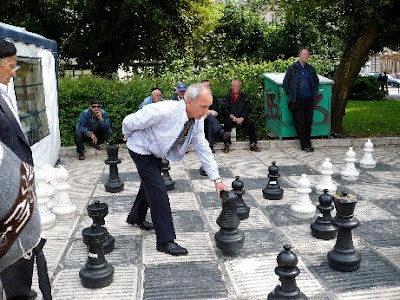
More sites were glimpsed with the Synod Orthodox Church standing out as a magnificent building. It was closed, so we strolled into the next door park to check out the market stalls. It seemed like a ‘snake oil’ market, with no crafts or foods, other than those that cure a hundred ailments or restore your youth. Some men were intently watching others move giant chess pieces in a do or die chess game. Sticks were being pointed to indicate moves by the coaches and the players were under pressure. Hopefully some of the pills and potions on sale were for restoring blood pressure to normal.
There was an interesting sculpture of a naked man in a globe, with an inscription that said in Italian and Bosnian ‘The world is built by multi-cultural man.’

The place of the assassination of Archduke Franz Ferdinand was just around the corner from the main road beside the river, near the arched Latin Bridge.

We were looking at the photos on display on the walls of the museum that now stands there when a young man came over and checked that we knew the importance of this spot. He was so intense that it could have been recent history he was discussing, and in fact he did tie the fact of one shot starting a war to the recent war. The museum was closed but we hoped to visit it the next day.

Crossing the river again, with fine drizzle falling, we looked at the reconstructed music pavilion in the park; a tall dark wood building with restaurants flaring out at its base.

Up the hill from there a woman posted a coin through the wire windows of each of the seven brothers in the burial chamber and then gave one to a beggar sitting on the ground where an eighth window would have been. We never found out who the brothers had been but the posting of coins is listed for tourists as a way of making a wish. Back near the river we visited the Emperor’s Mosque and couldn’t work out which Emperor it meant. Suleyman the Magnificent had ordered it to be built in 1566 when the Ottomans held sway and he was a sultan, not an emperor.

St Anthony’s Church was up a few streets; an impressive complex that required climbing steps up to a landing to visit. Inside it was large, simple and gallery like, with spectacular and vivid modern stain glass windows down the sides and at the front. In one striking window Jesus was shown in agony on the cross, his body elongated and his head arched back. Alcoves featured deep relief sculptures in wood, other modern religious art works in mosaic and metal, and large paintings. Although there was a gallery aspect to this church, the works contributed to a unity of intent and to the feeling of being in a holy place.

We raced through the rain, zipped back across the river on yet another bridge, but we couldn’t resist the beautiful city hall, built in the early 20th century, but designed by an architect, Alexandro Wittek, who the City of Sarajevo had sent to Cairo to study Islamic architecture and arts. His study was not wasted, with the façade decorated with stonework and arches reminiscent of many mosques. It must have been truly grand for the opening of parliament in 1910 and when Franz Ferdinand and Sophie attended a reception there in 1914, the last before their death. Now it has boarded up windows and some sections show fire damage. Other parts were perfect and it is a building of such uniqueness, grandeur and charm that I hope it is restored.

We decided to have dinner out but it wasn’t easy – the pizza shop was closed and every other restaurant we tried could not cater for vegetarians. At our last chance the waiter came up with mixed vegetables and rice, so we were happy and stayed to have a rare dessert of baked apple for me and pancakes with chocolate, jam and cream for Keith. Climbing up the hill, we returned home to our very comfortable hostel.

Below are scenes from the streets of Sarajevo demonstrating how beautiful the architecture is and the daily reminders of a recent and brutal war.